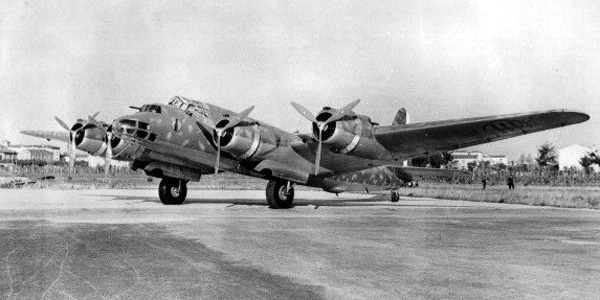
An original war concept
In 1933, the Japanese Imperial Navy published a very original program for a strike airplane with a very large combat radius.
The method invented for the proposed actions was original as, also, very daring:
- The new torpedo-bomber was supposed to attack, with torpedoes, enemy boats very far from the Japan.
- Thereafter, to save the crew, if no station was rapidly available, the only solution was to ditch the torpedo-bomber nearby a Japanese submarine (supposed to be already in the good place).
Obviously, the Japanese Navy expected at least two advantages from this warfare :
- A total surprise affecting all the attacked sailors.
- The deployment, by the surviving warships, of huge aerial and maritime recce means became necessary to avoid a new surprise. That imply also to detect the starting point of the offensive. Such a precautionary phase would induce a very carefully (= very slow) progression of the enemy forces.
Design
To obtain such a result, the Mitsubishi company conceived a bomber involving the most up to date concepts. She gathered:
- a very slim and streamlined fuselage (externally rather similar to a torpedo),
- her wings allowed easy take off with maximum charges,
- the landing gear was almost totally retractable,
- and the cockpit as also the combat positions were really well streamlined.
If Wikipedia tell us this bomber was inspired by the Douglas DC 2, I'm sure she shared a very important part of the Dewoitine D 33 record breaker blueprints that Mr. Emile Dewoitine had sell to Mitsubishi in 1933 (with also, may be, some informations about her military relatives, the D 337 and D 420).
The new bomber was designated as the G1M.
She was 15.83 m long, weighted 4,775 kg, empty, and 7,000 kg for take off, with a 5 men crew.
The wingspan was 25 m and the wing area totaled 75 m², demonstrating an aspect ratio of 8.33, favoring fineness and, thereby, total range.
The wing loading of 93 kg/m² - as also the Junkers Doppelflügeln system - allowed easy take off.
Unfortunately, if the 12 cylinders in W liquid cooled Hiro type 91 engine delivered the announced power of 650 hp, that was only at sea level: The absence of supercharger interdicted to maintain such amount of power at altitude.
The G1M flew first in April 1934.
Twenty-one preseries examples of this bomber were built and used in numerous (and hard) experiences.
The top speed was 266 kph at sea level. It was soon totally insufficient if they were facing all the fighter prototypes of the times.
The service ceiling was 4 500 m.
From the other hand, the bomber structure appeared as not very tough.
Fortunately for the Japanese Imperial Navy, some brand new radial air-cooled and supercharged engines appeared in Japan at this moment, and among them, the good Mitsubishi Kinsei.
The Imperial Navy ordered a new bomber taking into account the shortcomings of the G1M, so Mitsubishi answered with the G3M.
The fuselage was lengthened to 16.45 m, the wings remaining unchanged.
The take off weight was now 7,700 kg.
The maiden flight occurred in July 1935.
Two Kinsei engines delivering 910 Cv were used, and the to speed became 350 km/h at 2,000 m.
The service ceiling increased from 4,500 m to 7,500 m.
 |
| Mitsubishi G3M - Close from Nanking, 1938 |
The G3M was ordered for the production of about 30 examples for 1936 (G3M1).
The mass-production of a more powerful variant - the G3M2 - began in 1937 and was running until 1939.
The crew of this bomber increased to 7 men, taking into account the enhancing of the defensive armament.
A first set used Kinsei 42 engines delivering 1,075 hp at take off and 990 hp at 2,800 m.
The second set used Kinsei 45 delivered the same power for take off but had its critical altitude 1,000 m higher.
This variant hat a top speed of 375 km/h at 4,200 m.
She had a service ceiling of 9,100 m and a total range of 4,300 km.
The last variant, designated as the G3M3, had engines delivering 1,300 hp for take off and 1,200 hp at altitude.
The top speed was 416 kph at 6,000 m. The service ceiling was 10,000 m.
More than 200 examples were produced from 1939 to 1941.
The defensive armament, initially, gathered only 3 rifle caliber machine-guns; It was later enhanced either by adding a simple machine gun, or by a short 20 mm cannon of the MG FF F type.
In all cases, the maximum bomb load was limited to 800 kg.
The type 91 Mk 1 torpedoes weighted more than 780 kg including 150 kg for the explosive charge.
Japan used also this bomber (devoid of armament) for propaganda tours, as shows the below photograph.
.jpg) |
| Mitsubishi G3M2 during a propaganda tour in the USA in 1939: A very clean external finish. |
In 1941, the G3M production was stopped because the G4M began to equip the IJN bomber groups.
In action
The G3M (Nell in the USA) went to war at the end of 1937, during the Sino-Japanese war.
Taking advantage of their huge combat radius, they were used for the bombing of coastal target near Shanghai (this implying to cross, during some missions, about 700 km of the Japanese Sea).
These bombers were involved also in the 24/24 bombing of Chongqing.
Even they were protected by Imperial Army and Imperial Navy fighters, they often had to face Chinese fighters of the Kuomintang Army (whom leader was Chiang Kai-shek), which were mostly of soviet origine (Polikarpov I 15, I 15 bis, I 153 et I 16).
That bomber was not more armoured than her successor, the G4M (Betty), but she was clearly more slim, implying a weakening in the accuracy of firing by the attacking fighter or the AA guns.
Nevertheless, in 1941, the staff officers of the Imperial Japanese Navy thought this bomber was already obsolete.
But, since the beginning of the Pacific War, Japan need to use of all the existing bombers, including the G3M.
The December 10, 1941, the powerful British fleet dubbed Force Z, a fleet gathering the so-called "up to date" battleship HMS Prince of Wales and the battlecruiser HMS Repulse, escorted by the destroyers Electra, Express, Vampire and Tenedos, was in the Malaysian waters, in order to deter a Japanese disembarkment in this country.
In fact, the Allied forces were deceived by the IJN forces. The Force Z was instantly tracked by I-65, then by I-59 IJN submarines, as also by IJN recco floatplanes launched by cruisers of the IJN fleet.
When Admiral Tom Phillips left Singapour, he felt immediately in an ambush.
The combat initiated at 11:00.
Sixty G3M2 based in Saigon (in the then French Indochina) divided in two groups. The first one gathered 35 bombers. .
These bombers launched heavy bombs from high altitude (often said to be 3,500 m, but actually clearly higher, likely near 5,000 m as suggested by the personal diary of sub-lieutenant Albert Jacobs).
While the first group was creating an intense diversionary tactic, the group gathering the remaining G3M2 launched torpedoes.
The HMS Prince of Wales was hit by the first torpedo which struck the rear port part of the hull, near the outer port screw.
Initially, the damage was underestimate, but it was catastrophic: The steel shaft moving the screw had been totally bent by the explosion, opening numerous waterways in the different sealing partitions.
Then, there was no more electricity in the back half of the ship, inducing the shut down of the water pumps and, consequently, a 11.5° list to port.
This interdicted simultaneously the starboard 5.25 inch AA guns to fire against the remaining attacking torpedo-bombers, because the actual elevation of the guns was to strong to hit the incoming sea-skimmer planes.
From the other hand, the HMS Repulse escaped to 19 torpedoes (!), thanks to the outstanding skill of the commander William G. Tennant and to the excellent training of her crew.
Nevertheless, a bomb hit the battle cruiser, destroying her useless Walrus.
At this moment, 17 G4M1 brand new bombers were attacking the battlecruiser from both sides with torpedoes.
Two of the Betty were downed by the AA artillery fire of the Repulse and 8 were badly damaged.
Alas, the Repulse was simultaneously hit by 4 or 5 torpedoes: At 12:33, this proud fighter capsized with 500 sailors on board.
Six other G4M1 launched their torpedoes on the Prince of Wales: Among them, three had hit the battleship.
One 500 kg bomb completed the disaster.
At 13:15, the ship abandonment order was given.
At 13:20, the battleship capsized and sunk with 327 sailors, among them the Admiral Phillips.
In 2007, a visit of the wrecked hull of the PoW by divers demonstrated the first torpedo, the most important one, was less powerful than the last one.
The first explosive charge weighted 150 kg (type 91 mod.1 torpedo) launched by a G3M2 (Nell) and the last one, with an explosive charge of 205 kg, was a type 91 model 2 torpedo, so it was launched by a G4M (Betty).
This battle proved the highest deciders of the Royal Navy had not understood the lesson of their own victory against the Regia Marina at Tarento in 1940 and they did not think to the Allied defeat occurred only 48 hours earlier at Pearl Harbor!
However, the Japanese victory was a trompe l’œil one for the IJN, because Admiral Philips refused to involve the Brewster Buffalos of the RAF.
If Commander Tennant, who warned them, had warned them one hour earlier, even these fighters had a very occasion to down a large part of the Japanese bombers...
In September 1941, the RN flew the Spitfire V float plane (520 kph at the best altitude) for the first time.
Some British columnists asked for such sea fighter since the Norwegian Campaign of 1940.
It was certainly possible to speed up the development of this aircraft, knowing a similar transformation was scheduled in May 1940, using a Spitfire II airframe.
It was possible to expect at least 500 kph from such a fighter.
So, with 8 float Spitfire II instead of its 8 useless Walrus (weighting 3,700 kg at take off), the Force Z could have expected a very better fate.
Such fighters would have focused on the torpedo-bombers which were easy preys for them.
Everything happened as if it was intellectually impossible for Admiral Tom Phillips to imagine the Japaneses were able to plan such a mighty raid against his own fleet with only a formation of bomber and, above all, without any battleship to support them!
Patently, he had not a good knowing about the RAF experiments with the Cubaroo bomber between 1924 and 1926.
From the other hand, one may also wonder on some other points regarding the Force Z :
- The Repulse had 24 QF2 de 40 mm Mk VIII with which she downed 2 bombers and damaged 8 others.
- With 32 identical cannons, the Prince of Wales achieved no good results. Maybe, the training of the AA crews on board of the PoW was less efficient than on board of the Repulse.
- Even worse, for her AA defense, no destroyer had more than a single QF2 cannon (!); The 12.7 mm machine-guns were useless: They cannot do anything against the bombers flying at 5,000 m.
After such an important victory, the Nell military history was not over
Obviously, this bomber was an active player in the conquest of Philippines and Indonesian territories.
But the then amazing weakness of the Western colonialist powers (USA, GB, France and Netherland) gave us a biased picture.
By his own strategic conception, Admiral Yamamoto wanted, at this times, that Japan establish a bridgehead in Australia.
 |
| Darwin and the Bathurst Island are at the North-West of the Northern Territory. |
The Darwin attack by the IJN began by an important aerial bombing the February 19, 1942.
This raid have been thoroughly prepared by reconnaissance flights likely done by floatplanes on board of long range submarine cruisers.
The first strike was done by the bombers and torpedo-bombers on board of 4 (Akagi, Kaga, Hiryu & Sôryu) among the 6 carriers which had attacked Pearl Harbor.
The first wave constituted of 81 Nakajima B5N which were in charge of high altitude bombing or torpedoing, and 71 Aichi D3A dive-bombers.
Thirty six A6M2 Zeros protected the bombers but, also, conducted strafing attacks.
The A6 M2 downed first a Catalina flying boat.
Unfortunately, the RAAF guard officers, as usually at this early stage of the war, refused to take into account of the warning of a coast observer (the catholic RP McGrath) who warned them that an important amount of aircrafts in the sky of the Bathurst Island, heading South at 09:35. They interpreted these aircrafts as Allied going back from Indonesia.
So, the surprise was complete when the Japanese wave struck Darwin at 09:58...
At this moment, the Darwin harbor housed 65 ships of any purpose among them, many were supporting the Allied forces fighting against the Japanese forces in Indonesia.
 |
| Explosion of the Neptuna cargo le 19 - 02 - 1942. The Katooma patrol boat, in the foreground, escaped unscathed. |
After 30 minutes of strike, the Japanese bombers - among them 35 were more or less damaged - returned to their carriers.
They had sunk 11 ships and damaged numerous others.
Only one of the ten present P 40 of the USAF escaped the Zeros. The other ones have been downed or destroyed on the ground.
The second wave arrived on Darwin at 11:58. The alarm sirens, this time, gave an effective warning.
The English Wikipedia tell us the Japanese bombers were flying at 18,500 ft (= 5,624 m), but this is the official story telling.
From the other hand, Bernard Baëza, in his excellent book Soleil Levant sur l'Australie (Lela Presse, in French), indicates the G3M bombers were flying at 8,000 m.
That is clearly more consistent with the total absence of hit achieved by the sixteen 94 mm AA cannons than the official theory of a generalized shell detonator anomaly!
However, the Japanese bombers took the time (nearly one hour) to identify their targets and launch their bombs.
Such a comfortable situation for the Japanese airmen demonstrate the the British government had never expected the Australian territory could be attacked!
The aerial base was badly damaged.
Among the 30 destroyed aircrafts on the ground, there were six Lockheed Hudson, two P 40 and one B 24, reducing again the Australians capacities.
Six members of the RAAF were killed, as ca 250 others in this tragic day.
Wikipedia wrote the huge difference of casualties between the raid on Darwin and the raid on Pearl Harbor was the total absence of battleships.
It is not so simple: Australia is an almost désertic country in which the life is difficult. In 1941, Darwin was a tiny town with ca 2,500 inhabitants, but, at the same period, Honolulu had 180,000 inhabitants.
The human density was very weak, this reducing automatically the probability of lethal impacts.
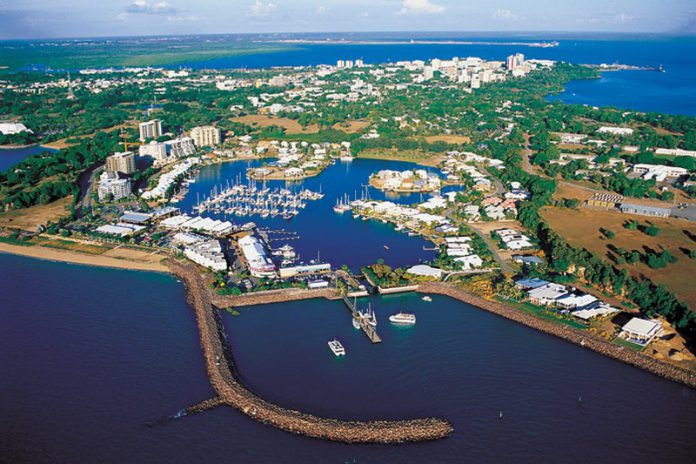 |
| Darwin at the beginning of the XXIst century |
Japanese bombers had dropped 114 tons of bombs, a total of the same order of magnitude than the 133 tons of bombs launched on Pearl Harbor.
A very odd inappropriate order, increasing the terror induced by the mighty Japanese raid, triggered robbery in the houses evacuated by their inhabitants.
This raid had an immediate effect on the fighting in Java and in Philippines.
The naval trafic dispersed in other harbors.
Numerous new airfields were built, very well camoufflaged, and USA sent a lot of Curtiss P 40 with their pilots.
The Japanese raids on Darwin continued for almost a year.
The first radar alerts were not very fruitful because the Curtiss P 40 could not climb sufficiently fast toward the flight altitude of the Nell bombers!
A significant change occurred only when Churchill accepted to send Spitfire Mk V which had similar climbing times than the A6M3 Zero fighter.
The first air clash were choking for the British fighter pilots who, initially, thought the Japanese fighters will be easy prey for them.
So, they experienced a serious disappointment when they discovered the large superiority of the A6M Zeros in dogfight.
But, for the Japanese, the Sptifire was also a bad surprise, because she was faster than all the Japanese aircrafts, including the 600 kph able Mitsubishi Ki 46 (Dina).
The worsening of the combats in the Solomon had the result to push the Japanese threats away from Darwin.
In the following - and last - operational period, the Mitsubishi G3M was restricted to the training role.