Showing posts with label engines. Show all posts

Thursday, June 28, 2018

The Fiat G 50 Freccia, a modern fighter (modified the February 14, 2024 *)


Engineer Giuseppe Gabrielli, belonging to the Italian trust Fiat  (as also Cesare Rosatelli, the designer of the Fiat CR 42 biplane fighter), begun to work in April 1935 on a monoplane low-wing fighter fitted with a retractable landing gear.

At this precise moment, a lot of military aeronautical deciders - in most of the countries - had a very good feeling about the fast and nimble Fiat CR 32.

The prototype of the new fighter - the Fiat G 50 (G for Gabrielli) - made her maiden flight in February 1937, a significantly shorter times than the one used by Mario Castoldi to design the contender fighter Macchi MC 200.

Her modern all metal structure displayed a clear contrast with the previous Italian Fiat fighters.


Fiat G 50 - Apart her characteristic hump, she displayed a smooth skin, an rather well streamlined engine cowling and the absence of any Karman fairing.


As for all other contenders, she used the bulky Fiat 14 cylinder radial air cooled engine A 74 RC 38 which delivered 840 Cv (diameter: 1.20 m).

The G 50 fighter had a length of 7.80 m.  

An unsightly hump was imposed by the military staff to obtain a better pilot visibility on the ground (losing about 20 kph in top speed in the air...).

The weight was 1,930 kg empty and 2,330 kg for take off (without bombs)
.


The wings had a span of 10.98 m and a total area of 18.25 m², allowing a wing loading of 128 kg/m².


Performances 

The top speed were:
  • 400 kph at sea level,
  •  473 kph at 4,500 m (or 5,000 m, following the different sources).
The Freccia was clearly faster than her biplane stablemate Fiat CR 42 (435 kph).

However, she was 35 kph slower than the Macchi MC 200 contender.


The Fiat G 50 climbing times were:
  • 5,000 m in 6' 05", 
  • 6,000 m in 7' 30" minutes. 

The service ceiling was circa 10,000 m, but differs a lot following sources (9,700 m to 10,700 m).

Such performances were good for the time, taking into account the "choice" of a radial engine and the rather low power available (840 hp).

One may find several value about the total range, which, obviously, was related to the very scarce tank (311 liters!).

The shortest value published was 445 km (En. Wikipedia), but that must be balanced by a rather fast cruising speed of 415 kph (~70 % of the maximum power).

The largest range value was 670 km (equivalent to the one of the Spitfire) at a slower cruising speed. 

Theoretically, the first value implied a combat radius of 150 km associated with a fighting time of 15 minutes.

The greater value implied a 200 km combat radius. 

Nevertheless, in September 1940, an extra fuel tank was fitted on this fighter (which became the G 50 bis. The new fighter had a total range of 1,000 km (En. Wikipedia , 1er § of the Variant I section.) 


Flying qualities


About the flying qualities, the picture was more complicated.

At the time of the Regia Aeronautica contest, the Freccia was judged as clearly more maneuverable than the Macchi MC 200. 

However, two lethal accidents demonstrated she was so not easy to handle by inexperienced pilots: Two pilots died while their too brutal maneuvers had induced flat spins at a too low altitude.

As in many other countries, the new fighters of the end of the 30's, which benefited from a speed increase of 25 to 30%, compared to the previous fighters their pilots were accustomed, were subject to an "abnormally" high accident ratio.

The g number for a same stick displacement was severely increased and the time needed to correct an inappropriate action at the vicinity of the ground was, obviously, not sufficient. 


Operational career


The Fiat G 50 were quickly send to fight in Spain were her better performances and maneuverability were praised. 


Historically, the better records of the Freccia fighter were obtained against Staline in Finland (during the two wars), with 99 soviet airplanes downed at the cost of only 3 Fiat fighters: A superlative kill/loss ratio of 33/1 !


In June 1940, the fighting between France and Italy lasted only 15 days (from June 10, 1940 to June 25, 1940). 

During that period, it's impossible to find any evidence of a battle occurring between French fighters and Fiat G 50 ones.

In the literature, you may found a flight over Corsica, but this action, if it existed, had no influence on the transferring flight of several units of the French Aéronavale towards the city of Bône (known today as Annaba) in Algeria. 


Nevertheless, the Fiat G 50 were sent to Belgium in September 1940, in order to participate to the Battle of Britain as well as the Fiat Br 20 they had to escort.

This action was a complete disillusionment for the leaders of the Regia Aeronautica, because the heavy loss ratio.

Some sources suggested they used the airfield of Maldegem, in the Ost of Bruges. 

In beeline, the distance between this place and London is near from 250 km. Owing to their tiny range, the Freccia fighters could not be very useful after crossing the English coast line (the nearest English coast being between Dover and Ramsgate at 120 km). 

A bit to late, a new variant of the G 50 (the G 50 bis) was released, incorporating an additional 100 liters tank. 
Amazingly, these fighters, which had a really better total range (1,000 km), were not transferred to Belgium, for some unknown reason...

The Italian participation to the Battle of Britain was, overall, a gesture of solidarity from Mussolini towards Hitler.

Unfortunately, if German pilots were able to rely on their air control, the Italian ones, devoid of any radio transmitters, could not do as their partners...

Moreover, the Flemish weather was not in perfect accordance with the open cockpit wanted by the Italian pilots who could not imagine they will be later sent to Russia, even during the Winter, with an average temperature of -30°C, two years later! 


They were also used against Greece in October 1940, with mixed results. 

Confronted to the Hurricane, the Freccia was better in term of tight turning - even if the wing loading of the Italian fighter was heavier than that of the British one - as, also, in climbing speed.

Nevertheless, these combats occurring at the beginning of the WW II (for an Italian point of view) may not be compared to those occurred one full year later. 

French of English pilots had survived confrontations with the Lutftwaffe (which used the best tactics and really excellent pilots), the best real training in the early 40's world.

That was not against the republican Spanish or soviet pilots the Italian pilots could obtain a "combat proven" tactical capability. 

Less than one year later, in 1941, they had learn the tricks of the job and became very difficult adversaries for any of their foes.


All told, two amazing criticisms


 I - For example, British writers told us some Bristol Blenheim IV escaped successfully to Freccia fighters.

What a beautiful narrative! The standard reader is induced to believe the Bristol Blenheim to be a very fast bomber, able to escape undamaged from the attack of a Freccia fighter.

Unfortunately, the maximal speed of the Blenheim Mk IV was 428 kph at 3,600 m, 45 kph slower than the Italian fighter!

Fortunately for the Italian pilots feeling, the cool weather of Flanders was a perfect protection against overheating of the engine or against any kind of sand wind, so it was clearly impossible the engines of the Italian fighters seized! 

The 45 kph speed excess of the Freccia must be translated in a gain of 750 m for each minute of pursuit! So, an Italian pilot using his G 50 fighter was able to catch up a gap of 10 km in 13 minutes and 20 seconds.

Moreover, such a computation is only based on the best horizontal speed of the Blenheim.
Nevertheless, the Freccia had a lot of other tactical advantages (huge acceleration, very tighter turns, fast altitude changes).

This narrative may be a political fake, or may be attributed only to the very bad visibility occurring very often in the region and totally unknown in Italy or in Libya. 


It's not possible to use of that to discredit this fighter. 

May be, it would have been more honest to highlight the lack of radio-transmitters which might allow a shorter pursuit time.


II - Another critic regards the armament. 

The same authors wrote the Italian armament was "too much inferior" to the British one.

First, to express such a critic about such a subject, one may avoid any anachronism. 

The armament of the first operational Bf 109 E1 (1939) consisted only in four MG 17. It was very efficient against the PZL 11, fitted with only 2 light machine-guns. 

OK, three years later, in November 1942, the early P 47  had eight 0.5 cal. machines guns, but this fighter had a very stronger power plant (more than 2,000 hp) which was absolutely not reliable in 1939! 

In 1939, the Hurricane, with her eight 7.7 mm machine-guns, had some superiority against the German Bf 109. 

But, against the Italian fighters, which used two Breda-SAFAT 12.7 mm machine guns, things were not so easy because each of the 34 gr bullet was travelling at 765 mps. 

If the Italian heavy machine-guns had a slightly slower muzzle speed, their three time heavier bullets conserved easier their speed and trajectory owing their stronger inertia, favoring a ripple firing at a distance of 400 m. 


A very brilliant heir


Engineer Gabrielli, interested by the inline inverted Vee liquid cooled Daimler-Benz DB 601 of the Bf 109 E delivering 1,050 hp, used this engine to create the Fiat G 50 V.

The prototype first flew in August 1941. 

Even better performer than the original Freccia, her perfecting was too long to compete against the similarly powered Macchi 202 Folgore. 

So, Gabrielli chose to by-pass this step and developed the Fiat G 55 Centauro, with the more powerful engine Daimler-Benz DB 605 A delivering 1,475 Hp. 

Her length increased from 7.80 m to 9.37 m. 

The take off weight increased from 2,330 kg to 3,520 kg.


Fiat G 55 -  A shape rather similar to that of the French Arsenal VG 33 series, of 1939-1940

The wings had a span of 11.85 m, the total wing area was 21.11 m² (~3 m² more) so, the wing loading was 167 kg/m², a value allowing a good maneuverability while other fighters were losing this capability.

Without any water injection, the top speed was 625 km/h at 7,000 m.

The service ceiling was 12,750 m.

The climbing time to 6 000 m was 5' 50" 

             "          "    to 7 000 m was 8' 57".

The armament was a 20 mm cannon in the engine and four 12.7 mm mg. 

The maneuverability of the G 55 was excellent, especially at high altitude.

The German pilots wanted that the German plants build this aircraft...


.


Monday, February 19, 2018

The Regia Aeronautica: Good planes, good pilots... no leadership, nor clear objectives (Revised the January 23, 2019)


 {Independently from the usual sources  (Wikipedia in Italiano or in English or in Deutsch), an anonymous Italian correspondent gave me this very interesting source.}

The Italian Aviation was, during the 30's, a very strong military force that no one among the European countries might neglect.

Its aircrafts shared excellent flying qualities and the Italian pilots were very well trained and they were able to be efficient in very efficient daring missions.


The high level of the Italian pilot training was demonstrated by the fact that numerous German fighter aces (e.g. Adolf Galland) followed this training.


Technologically speaking, Italy owned the absolute Air Speed Record during 5 years (from 1934 to 1939) with the floatplane Macchi MC 72, which achieved the speed of 709 kph.


Moreover, the August 28, 1940, Italy was the second nation to fly a very jet aircraft, with the great Mario de Bernardi at the controls.


The Campini-Caproni N1 on this site - The shape of this jet foreshadowed those of 50's fighters. The choice of a two-seater configuration explained the heavy weight of this aircraft and the thick wings were responsible of excessive drag.


Nevertheless, the role of the Italian aviation is often neglected: That may be attributed to the war propaganda emitted from a lot of countries. 


One of the key issues which affected the Regia Aeronautica was the inconsistency of its engine industry. 
Numerous interesting engines were developed, but few were really perfected, because of the overwhelming influence of the FIAT lobby.


During the war in North Africa, Italian aircrafts suffered also greatly from the lack of anti-sand device, this being of paramount importance especially in Sahara... So, the full lifespan of their engine dropped to 30 hours (Giancarlo Garello, Bataille Aérienne n°55, la guerre sur le désert : la Regia Aeronautica au combat, part #1, in French).


The Italian Air Force had created 
very well organized bases in Africa. 

Unfortunately, these bases were very few, inducing an excessive concentration of aircrafts, a fact appealing for Allied aerial bombings. 
But these bases lacked both of AA artillery and ground protections against commandos (so, numerous airmen were killed on the ground), this inducing the use of inexperienced pilots.


The fighters


The Fiat CR 32 of 1933-34 mastered completely the Spain skies during the Civil War. 

Easy to handle, with actually excellent performances (except at high altitudes), outstandingly maneuverable, she outclassed the elder
 Nieuport 52 (of 1929), but also their contemporary Russian fighters Polikarpov I 15.

Unfortunately for Italy, in 1940, the Regia Aeronautica was not more so healthy. 
The Spain Civil War was costly from an industrial point of view: Almost 800 aircrafts were supplied to the Aviazione Legionaria, among them 360 Fiat CR 32 fighters, and most of the surviving aircrafts were supplied to Spain after the victory of General Francisco Franco.


After the choice of the Messerschmitt 109 by the Luftwaffe, of the Hurricane and of the Spitfire by the RAF, Italy chosen two really modern monoplane fighters, the Fiat G 50 and the Macchi MC 200. 


The best of them, in 1940, was the Macchi MC 200 Saetta. She was an excellent interceptor, with a good armament, outstanding flying qualities and good performances.

Another monoplane was present in the same contest, the FIAT G 50 Freccia, of the engineer Gabrielli. This fighter was not as efficient as the Folgore, but she had a very excellent progeny.


Unwisely, after some accidents experienced by pilots flying the new monoplane fighters, the great success of the biplane CR 32 induced also an order for her direct biplane successor, the Fiat CR 42.


None of these fighters were conceived for a rapid mass production. 

From 1939 to 1943, only 1,850 examples of the two monoplanes - MC 200 + G 50 - were built (to be compared with the French fighters between January 1939 and June 24, 1940: MS 406 + Bloch 151/152 +  Dewoitine 520 = 2,100 exemples!).

Alone, the CR 42 was built in ~1,800 exemples...
||--------- The FIAT CR 42 Falco: An excess of conservatismampaigns.|---------------------------


The Italian bombers 


These aircrafts were well designed and allowed all the spectrum of the bombing missions.


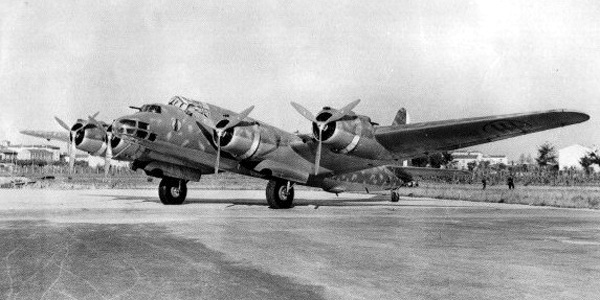
The FIAT BR 20 Cicogna was an excellent and tough twin-engined bomber with two FIAT A 80 RC 41 18-cylinders radial engine delivering 1,000 hp each.

She was 16.68 m long. Her empty weight was 6,500 kg, her take off weight was 10,100 kg.

The wingspan was 21.56 m and the win area was 74.00 m², giving a wing loading of 136 kg/m².

The top speed was 430 kph à 5,000 m and she might be loaded with 1,600 kg of bombs. 

The total range, with a bomb load of 1,000 kg, was 1,800 km at the cruise speed of 325 kph at an altitude of 5,000 m. She consumed 2,400 liters of fuel (1,800 kg) and 150 kg of oil.   

This bomber was reliable but the lack of ergonomic consideration of the Italian industry induced a too long building time, explaining that only 600 examples have been produced at the end of the combats against the Allies.


The Italian crew generally preferred the wooden tri-engined bombers.

The most famous of them were the Savoïa-Marchetti SM 79 Sparviero torpedo-bomber.

She was 15.60 m long, her empty weight was 6,800 kg and her take off weight was 10,500 kg.
Her wingspan was 21.20 m and the wing area was 61.70 m², giving a wing loading of 170 kg/m².

She was powered by 3 Alfa-Romeo 126 RC 34 delivering 750 hp each at 3,400 m.

The climb time for 4,000 m was 13.15 minutes.

The total range, with a bomb load of 1,000 kg, was 1,850 km at a cruise speed of 360 kph at an altitude of 5,000 m. 

That task was consuming 2,400 gaz liters (1,800 kg) and 150 kg of oil. 


Savoïa-Marchetti SM 79 - The scourge of the British Navy in the Mediterranean Sea

As a torpedo-bomber, she played a very important role against the Royal Navy, sinking or damaging heavily, among other ships, 4 destroyers, 6 cruisers, the battleship Nelson and the aircraft carrier Indomitable (the Nelson needed seven months for repairs, most of the other damaged ships needed one full year!). 


This bomber was built in 1370 examples.


The CANT Z 1007 bis, designed by engineer Zapatta, was a larger airplane. 

She was 18.35 m long.

Her wing span was 24.80 m and the total wing area was 75 m².

The empty weight was 9,400 kg and the take off weight was 13,600 kg: Her wing loading was 180 kg/m².

She could fly at 460 kph and could carry a bomb load of 2,200 kg . 

The total range was 1,800 km.

She can carry a bomb load of 900 kg at a cruise speed of 370 kph (at an altitude of 5,000 m), consuming 3,000 fuel liters (2,230 kg) and 240 kg of oil.


Unfortunately for their crews, the wooden structure was unsuitable for the extremely cold winter conditions in USSR, likely because using some inadequate gluing materials.

She was built at ~ 600 examples.


The Regia Aeronautica also used a true ground attack aircraft, the Breda 65 single engined by a FIAT A 80 delivering 1,000 hp.

This little aircraft was 9.30 m long. 

She had an empty weight of 2,400 kg and her take off weight as single seater was 2,950 kg (3,500 kg  when used with a rear gunner).

The wingspan was 12.10 m and the wing area totaled 23.5 m².
 So, the wing loading was 125 kg/m² as single seater and 150 kg/m² with the gunner.

The top speed was 430 kph.


Breda  65 with the rear gunner cupola

The forward firing armament was two 0.5 cal machines guns and 2 riffle caliber. The rear gunner had a 12.7mm machine gun.

The max bomb load was 1,000 kg, but only the bombs attached beneath the wings were releasable in dive (with an excellent accuracy).

218 examples of the Breda 65 were built, with only 150 examples entered in Italian service. 

In the North African desert war, they were really efficient when they were correctly used. Nevertheless,  since mid 1941, the Allied fighter (P 40 D, Spitfire or Hurricane) were too fast for the escorting biplane fighters.


Italian engineers developed also an excellent strategic bomber, the Piaggio 108 B which proved to have excellent qualities.  


Piaggio P 108 B - on this site - A real flying forteress. 

She went into service at May 1941. She was a four-engined all-metal bomber.

She was 22.92 m long with an empty weight of 17,325 kg and a take off weight of 39,900 kg.
Her wingspan was 32.00 m and the wing area was 135.54 m². The wing loading was 220 kg /m².


The engines delivered 1,350 Cv at an altitude of 3,500 m .

The service ceiling varied from 6,000 to 8,500 m, according to the actual weight. 

The top speed was 430 km/h at altitude. 
The cruising speed was 370 kph, above the top speed of the Armstrong-Whitworth Whitley!

The total range, with 10,000 kg of fuel, was 3,500 km at 320 kph at an altitude of 4,000 m when carrying a bomb load of 1,000 kg


The defensive armament was extremely powerful for the times, with six 0.5 cal. machine-guns and 2 riffle caliber machines guns housed in remote controlled turrets, (a very innovative layout). 


The heaviest bomb load was 3,500 kg.


Only 35 Piaggio P 108 were built but an improved bomber, the P 133 was scheduled to replace her.
Using more powerful engines (1,450 hp each), she was faster (450 kph) and her total range was 4,300 km at 370 kph.  


Knowing the qualities of the Piaggio P 108 and P 133, one may wonder about the lack of interest of the German Luftwaffe about these bombers which constituted excellent substitutives for any Ural bombing mission... 


Conclusion


In the so-called Italian failure, neither the aircrafts nor their pilots can be really questioned. 

So, the problems regarded:
  • The high command, which appeared always as "asleep";
  • The lack of early warning systems as also of radio-communications;
  • The AA artillery appeared also too insufficiently trained (this fact being illustrated the June 28, 1940, when it downed the SM 79 of the Marshal Balbo, killing their own commander in chief in North Africa, a point related to the problem of the high command…).


Saturday, October 18, 2014

The Westland Whirlwind, an outstanding fighter suffering from breach of faith from the RAF staff (revised 29 / 10 / 2017)


Wanted: A fighter with a real punch...


It is likely that, in 1934, after the successful trials of the French Dewoitine D 501 fighter fitted with the moteur-canon Hispano-Suiza 12 X Crs, the British deciders began to be worried with the possibility than a few fighters could be able to destroy easily the aircrafts of the Bomber Command.  

The actual Hawker Fury II fighters (of rather similar performances) were fitted only with 2 riffle caliber machine guns (muzzle velocity of 744 m/s & 250 rounds, each bullet weighting ~0.011 kg).

The first response of the British Air Staff was to increase the number of machine guns up to 8 as also to use of very better Browning M 2 MG of the same caliber (muzzle velocity of 850 m/s). So was the armament of the Hurricane Mk I and Spitfire Mk I.

But some undoubtedly very advanced twin-engined fighters (Potez 63 and Messerschmitt Bf 110) appeared in 1936 with 2 cannons in the nose. 

Appearing as a British answer, a program (F 37/35) was published in 1935 by the RAF staff, requiring a twin-engined fighter fitted with 4 efficient 20 mm cannons.


The very good work of Teddy Petter


The winner of the contest was the Westland Whirlwind designed by Teddy Petter. 

The layout of her airframe achieved a spectacular fineness and each detail revealed as thoroughly conceived: This aircraft was a very promising fighter issued from exceptional aerodynamics studies.


Several Whirlwind flying at low-medium altitude


This fighter was not much larger than a Hawker Hurricane (a lenght ofless than 10 m and a wingspan of a bit more than 13 m). 

The structure was totally metallic, with duraluminium stressed skin.

The narrow monocoque fuselage, made of magnesium, was rather cylindrical with a cockpit canopy rather similar to that of the French Nieuport 161 fighter in 1936.

The tail had the horizontal stabilizer mounted very high on the vertical tail.

The wings totaled 23.2 square meter, 0.7 m² less than the Hurricane Mk I (!) and was fitted with Fowler flaps.

The empty weight was 3,770 kg and the weight increased to 4,660 kg for take off (Whirlwind I, i.e. fighter only), so the wing loading was 200 kg/m².

The engines nacelles were very well streamlined and the engines were two Rolls-Royce Peregrine, last variant of the well known Kestrel. 

Each of these engines had a displacement of 21 liters and delivered 880 hp at 3,000 m (10,000 ft) using octane 100 fuel. The dry weight of one engine was 520 kg.

The chosen armament was one of the strongest of all the WW II fighters: Four Hispano-Suiza HS 404 20 mm cannons gathered in the nose. 

That was much more than twice the armament of the Messerschmitt Bf 110, which had only 2 MG FF Oerlikon cannons. 


The Hispano -Suiza 404 had a muzzle velocity of 880 m/s, 280 m/s faster than the MG FF, each shell weighting 130 gram. 

So, its ballistics was very better and its kinetic energy was at least, twice that of the Swiss cannon.

The first flight of the Whirlwind occurred on October 11, 1938.

The top speeds of the Westland fighter were:
  • 500 kph at 1,500 m,
  • 540 kph at 3,000 m,
  • 580 kph at 4,500 m, some 20 kph better than the Spitfire Mk I at this altitude (one may also compute that, with 720 hp Kestrel engines, this top speed would drop to 525 kph). 
The climbing ability was good:
  • 3,000 m in 4' 00",
  • 6,000 m in 8' 30" (one minute faster than a Hurricane Mk I).
These climb times were similar to those of the Hawker Typhoon which was only 10 kph faster at 15,000 ft, but much more faster at both lower and higher levels.
The service ceiling was a bit more than 9,000 m, a rather disappointing performance, but the logical consequence of a weak supercharger.

The stall speed of the Whirlwind was on the high side (153 kph), nevertheless, her maneuverability was outstanding, especially because her ailerons were much more efficient and pleasant than those of the actual Spitfire Mk I at high speed.

Four hundreds of Whirlwind (two series of 200) were ordered in January 1939.

The first productions fighters were delivered in June 1940 to 25 Squadron, a night fighter unit, but they were removed and transferred in July 1940 to the 263 Squadron which was in total reformation after having lost 10 pilots (among them were the 3 officers commanding the unit!) in the sinking of the Glorious carrier, at the end of the Battle of Norway.

The Westland Wirlwind production was slow essentially because Rolls-Royce had not finished its Peregrine engine, and so, delivered them at very slow tempo.

In action...


If you expected to have an idea of the capacities of the Whirlwind against the Luftwaffe during the Battle of Britain - because the first productions fighters were delivered in time - forget it: On October 17, 1940, Air Chief Marshall Hugh Dowding forbade any apparition in the Battle of the 263 Squadron, and, today, we don't know if his decision was motivated by problems linked to the fighter or to an insufficient formation of the pilots (or both..).

Latter, the 263 Squadron moved to Exeter and was, at last, operational the December 7, 1940. 

Most of her job was to destroy the German E-Boats used to rescue the crews of the bombers damaged by the RAF. 

The first aerial engagement occurred the January 12, 1941 and was against a Junkers 88 which was probably downed in the Western Approaches.

After this victory, the Whirlwind  obtained numerous others victories against Ju 88, Dornier 217, Messerschmitt Bf 109 and Bf 110, during Rhubarb missions over English Channel, Northern France and Belgium.

She was also used to escort 54 Blenheims gathered to destroy power stations near Cologne the August 12, 1941. 

Owing to their 500 km combat radius, the Whirlwind were forced to turn back at Antwerp. 

Ten bombers (less than 20%) were lost, such losses being negligible compared to those of Allied bombers (from 30 to 90%) during the Campaign of France in May-June 1940.

At low altitude, the Whirlwind was extremely efficient against the German fighters.

She was very efficient too against small ships and a lot of terrestrial targets, as locomotives, tanks and so on, demonstrating the heavy punch of her armament.

The 137 Squadron was the only other one to be Whirlwind equipped (since September 1941). It used the fighter to drop 125 or 225 kg bombs.

The 263 Squadron also used of the bomber variant, including in dive, as they had done from October 24 to November 26, 1943, against the German blockade runner Münsterland in dry dock at Cherbourg.

With 12 Whirlwind, they dove from an altitude of 3,600 m down to 1,500 m, facing a very strong Flak fire. 

The bomb impacts were quite all in a circle having a diameter of 150 m. 

Only one Whirlwind was lost. 

One may highlight that such a dive induced necessarily a strong acceleration but the pilots never complained about handling difficulties. 

One may underline the soundness of this fighter, very difficult to destroy for her enemies and very protective for her pilots.


The November 29, 1943, the RAF decided to equip the pilots of both squadrons with Hawker Typhoon.

I'm not sure that was a wise decision: The Hawker fighter was not better adapted to high altitude flying than the Whirlwind, she was less maneuverable and her Napier Sabre engine was even less reliable than the Rolls-Royce Peregrine...

Overwhelmed Rolls-Royce engineers ?


Knowing the great area of competence gathered in the Rolls-Royce company, the problems which plagued the Peregrine engine may be seen as amazing.

This engine was nothing more than a boosted Kestrel, differing by an adaptation to the 100 octane fuel and by its HM Hobson carburetors, fitted behind the engine to allow more space for the supercharger, and, theoretically, giving a more efficient mixture. May be, these devices have been chosen to profit from the automatic Hobson boost pressure regulator (source: Flightglobal / Archive). 

However the Peregrine lost quickly its power above 6,000 m and had overheating problems (due to formation of vapor bubble in the liquid cooling circuit when used too long at full power) and probably other ones. 

At that very moment, the Rolls-Royce company was, simultaneously, developing 4 other aeronautical engines: The Vulture (a twin Peregrine in X), the Exe (another X-24 engine), the Griffon (derived from the R of the Schneider Cup) and, obviously, the famous Merlin. A very heavy task!

Very early, the Rolls-Royce staff expressed the wish to abandon the Peregrine engine. 

May be, such a wish influenced the RAF deciders who decided to stop the construction of the Whirlwind. 

Was it the good decision? I'm not convinced at all, because: 
i) Most of the problems encountered were likely easy to solve (for example, the vapor bubbles could likely be eliminated by fitting degassers in the liquid cooling circuit). 
ii) The compressor problem would be solved by changing the actual device for another.
iii) Solving these problems could have good consequences on the Vulture finishing (amazingly, the Vulture was proposed for the Hawker Tornado before the Peregrine was, at least, completely reliable). It seems not to be a good method.

From the other hand, a lot of work was spent by the company to finish the Griffon. 
Nevertheless, this powerful engine was operational primarily in Spring 1943 with the Spitfire XII, and mainly, but too late, in mid-1944, with the Spitfire XIV, at the very moment the piston engines were losing their supremacy in favor to jet reactors and the Merlin appeared to achieve quite similar performances (Merlin 130/131 fitted on the De Havilland Hornet) without the same handling difficulties. 


True shortcomings


However, as any other aircraft, the Whirlwind was not perfect. 

A range problem?

It was written that the most impeding characteristics of the Wirlwind was her rather short autonomy, but this data is not easy to obtain. 

Green, in Fighters #2, gave only the information of an escort flight "as far as Antwerp..."

The same author, associated with Swanborough, in The Complete Book of Fighters, gave a total flight time of 1 hour and 15 minutes, translatable to 725 km at the top speed of 580 kph (not very consistent with the overheating at full speed) or 512 km at 410 kph (50 % of the power - an unrealistic value) . 

In the Wikipedia in English article on this fighter (October 15, 2014) you may found two other values: 
  • In the text, the combat radius was given as ~480 km. 
  • But, in the specifications, the total range is published as 1,288 km (an amazingly precise data!), but, at low level, the combat radius was 240 km, with normal reserves. 
These last data appear as the more likely, but underline how heavy was the fuel consumption at low level (twice the "normal" one).

So, the autonomy of the Whirlwind was of the same order of magnitude than those of Potez 631 and Messerschmitt 110 twin engined fighters.

OK, her range was half of those of the Bristol Blenheim Mk I F, but the Whirlwind was a true fighter, not the the Blenheim (the night fighting being a completely different task).

It seems that nobody want to fit some jettisonable tanks on the Westland Whirlwind. 

The idea of jettisonable tanks was invented by German for the Messerschmitt 109 E 7 in Fall 1940.

Such a device could have given a clearly better range, enabling the escort of the aircrafts of the Bomber Command to strike at daylight the German target with reduced losses, allowing them a much more military and economic impact.


Useless as a cannon fighter? 

The English Wikipedia article (October 17, 2014) on the Whirlwind is often excellent.

However, the authors wrote that, since the appearance of the Spitfire I B (with 2 Hispano-Suiza HS 404 cannons) during the Summer of 1940, the RAF did not have any more need of the Whirlwind. 

May be, these authors had completely forgotten the Spitfire story!  

The very thin wings of the Spitfire I were not conceived to withstand the strong efforts occasioned by the fire of such powerful weapons. So, they jammed quickly when fitted with HS 404 cannons.

Supermarine resolved the problem with the universal or "C" wing introduced operationally clearly later on the Spitfire V C, at the end of 1941, very, very later!


Another motivation may be the awaited delivery of the first Lockheed P 38 fighters (whose first flight was done the January 27, 1939). 

Lockheed, very optimistically - as usual with this company - claimed a top speed of 640 kph (400 mph), 60 kph faster than the Whirlwind. 

But the Lightning to be delivered did not fulfill her promises. 
  • Deprived of her turbo-superchargers (by order of the US Congress), she was not so fast. 
  • With her 2 engines running the same direction, the P 38 was very difficult to handle. 

  • Owing to her weight of 6,140 kg, her maneuverability was, at least, very questionable.
Justifiably, the RAF refused these P 38.

Consequently, the RAF pushed for the service entry of the Typhoon, long before her teething troubles were eradicated (23 pilots lost their life after tail losses, a problem solved only at the end of 1944!). 


My (very) iconoclastic solution...

There was two parts of a true solution, easy to use since 1939.

The first part was to eliminate 2 canons (each HS 404 cannon weighting 48 kg + 25 kg for the drum with 60 shells), allowing space storage for ~200 litters of supplementary fuel.

The second part of the solution (unacceptable for English deciders ;-)) was to replace the Peregrine engines by French Hispano-Suiza 12 Y 29 engines of 810 hp for take off and 920 hp at 3,600 m. 

This engine had a dry weight of 475 kg (source: Danel & Cuny, Le Dewoitine 520, Docavia #4), allowing a total gain of 90 kg. 

Such a solution could allow a top speed of 590 kph at 5,000 m, an elongated combat radius and more diverse missions...


Some lessons...


The December 18, 1939, three squadrons of Vickers Wellington (22 bombers) were sent to bomb some the Wilhelmshaven facilities and shipping. 

The distance between Great Yarmouth in East-England and Wilhemshaven in Germany is a bit less than 450 km. 

No actual RAF fighter was able to escort these bombers. 

If someone wanted to use of Spitfire Mk I, they would need to land in the Netherlands for refueling!

So, 12 of these British bombers were downed and 3 others were badly damaged by a group of Messerschmitt Bf 110.

The British staff take this event into account and preferred to use his bomber for night bombing.

Nevertheless, such an escort duty was possible for the Whirlwind without any supplementary tank, allowing her ~15 minutes of combat. 

It is quite obvious the Westland fighter was superior to the Bf 110 because she was 40 kph faster, more nimble (~2,000 kg lighter) and she had a very stronger punch.

Neglected for such missions, the Whirlwind was used without neither strategic nor even tactical imagination, as if the RAF deciders have not read her handbook.

During the Battle of Britain, the same deciders used of their very poor Blenheim Mk I F or Mk IV F, with a top speed of 420 kph at ~3,700 m, a climbing time to 4,500 m of 15 minutes, a take off weight of ~6,500 kg, an armament of 5 forward firing riffle cal. machine guns. 
These characteristics explained perfectly the massacre (44 losses) they suffered during the Battle of Britain.

The only good news was a total range of 2,200 km and sufficient room to embark a radar.

OK, the appearance of the Beaufighter was a relief to the British night fighting. 

A top speed of 520 kp at 4,500 m, a service ceiling of ~8,600 m and 4 Hispano 20 mm cannons were obtained. 

But the take-off weight increased to 9,000 kg, only 450 kg less than the Boulton Paul Hampden bomber...  


The Whirlwind was, undoubtedly, a very better fighter. 

The first proof was simple: The last British piston-engined fighter, the gorgeous De Havilland Hornet, was a transposition of the radical ideas expressed in the Whirlwind, with a more sexy shape.

The second proof of the excellence of the concepts developed by Teddy Petter was the Whirlwind can fly over German occupied territories during 3 long years of war without any real modification.

She as all qualities to fulfill a lot of task and her survivability was one famous asset.

She needed only a better Air staff...