Up to the last half of the 70's, the torpedo was, by far, the most efficient naval weapon.
Even today, it remains lethal for every boat but those using hydrofoils.
Between WWI and WW II, the French seamen had spent a lot of time to perfect torpedo bombers and the torpedoes they need.
At the beginning of WW II, the September, 3, 1939, the crews, the aircrafts and their weapons were perfectly operational.
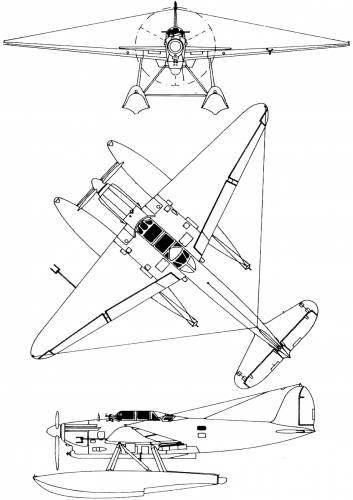
Amazingly, if the excellent Latécoère 298 float-planes were really intensively used, that was never for torpedoing, the main task they were intended to do...
Nevertheless, the French flying-sailors were always excellent professionals.
Having good aircrafts and torpedoes, able to use of efficient tactics and well trained, it was expected they shall have an impressive list of winners.
As this was not the case, so any citizen may wonder why such a paralysis occurred.
The naval torpedo, the first self-guided weapon of the Human History
The automotive torpedoes were created in 1866 by the great British engineer Robert Whitehead.
They were the first "missiles" - obviously submerged - whose trajectories where auto-regulated, without any kind of computer and they remained, for near a century, the most sophisticated and the most deadly weapons in the World.
Since the James Watt automatic regulator (1788), the best engineers of the XIXth century were very interested so solve all kind of industrial automatic regulation.
The depth of under-water navigation was an extremely complicated problem, especially as there was, actually, not any dedicated measuring instrument nor real experience.
The French engineers Bourgeois and Brun, who conceived the first autonomous submarine Le Plongeur, were not successful in this way between 1864 and 1867 (partly, by the lack of patience of the complete staff).
Robert Whitehead, who knew this story, linked a piston exposed to the water pressure to an elevator: When the depth was increasing, the elevator position was modified to climb towards the surface and inversely if the depth was decreasing.
However, with this only one sensor, the depth varied vertically for a total amplitude of about 12 meters. Obviously, such an amplitude was unacceptable for a submerged torpedo intended to destroy an ironclad.
Then, Whitehead linked the piston to a pendulum and the elevator to the pendulum.
The amplitude of the depth variations were no more than 0.15 m (15 cm): The depth oscillations were perfectly controlled.
A still current important advantage of the torpedo, resides to the impact zone well under the water line, were the armor plates are very thin or absent.
In 1870, the precise use of such a weapon was impeded by the very short range of the existing torpedoes.
Nevertheless, the first Whithead torpedo attack occurred at the end of December 1877, when the Russian torpedo boats Sinop and Chesma sank the Turkish monitor Mahmudieh. The torpedoes have been launched from a distance of only 65 m!
This resulted from the last remaining regulation problem to solve: The lateral stability of the torpedo, in order to conserve a straight course, not disturbed by currents or other events.
As late as 1896, Whitehead implemented a gyroscope (similar to that of Foucauld but patented by the Austrian engineer Ludwig Obry) which gave a straight course to the torpedo, allowing a considerable longer range of several kilometers.
The efficiency of the principles used in the guidance of the Whithead torpedoes was perfectly illustrated in 1942 by the Japanese ones belonging to 93 type (dubbed Long Lance in the US), able to run 40,000 m (21.6 NM) at 35 kts, swimming about 37 minutes, an amazing performance when most of the actual Aamerican torpedoes were limited to about 13,000 m (7 NM) at only 25 kts (for a time of ~17 minutes).
The Japanese torpedo type 93 (of 61 centimeters in diameter) carrying a huge 780 kg explosive charge, it is easy to see how deadly was the threat for any concentration of ships in a small area.
The only Allied torpedo approaching this performances were the British 24.5" Mk I torpedoes, only fired by the Nelson class battleships, which were able to swim about 18,500 m (10 NM) at 30 kts (for a time of 20 minutes).
The torpedo-bomber aircraft
If you want to launch at least one torpedo from an aircraft, you must carry this weapon on board of a mighty bomber, because a torpedo is a ponderous weapon.
Obviously, the torpedo is not only an explosive weapon, it is also a complicated vehicle :
- The explosive charge (150 to 300 kg),
- The guidance mechanism already described,
- A powerful engine allowing a significant speed during up to 37 minutes.
- A robust and streamlined structure one may assimilate to a micro-submarine with fin and rudder.
That implied this weapon had a weight heavier than a 12" (305 mm) battleship shell. The first reliable aircrafts were not sufficiently powerful to carry operational torpedoes.
The Italian captain Alessandro Guidoni was the first to develop the brand new method consisting in launching a Whithead torpedo from an aircraft (a Farman MF 7 with an engine of only 70 hp). After some tests, the trials were stopped owing the weak power of the used engine...
Britishs claim the first sinking of a enemy ship by an aerial torpedo during the Dardanelles affair, when a Turkish tug wanted to capture a Short 184 float-plane (240 hp) which had sea landed owing to an engine problem.
The problem of the engine was caused by the combination of an unusual air temperature for UK and the huge military charge (385 kg).
The crew of the seaplane had no other solution than to launch the 1888 torpedo after having properly oriented the plane. The tug was destroyed.
It's difficult to accept this true war victory as an aerial torpedoing, because the aircraft crew had no problem to launch the torpedo, behaving as a simple boat...
After releasing of the torpedo, the Short 184 was able to take off easily and return at home.
The first really operational aerial torpedoes were only available at the end of WW I, when powerful aircrafts were available.
Nevertheless, the actual aerial torpedoes were not very different from those used by destroyers or submarines, weighting less than 900 kg (2,000 lb).
In the same time, the larger vessels, cruisers or Battleships, were able to launch much more powerful torpedoes of 53 to 64 cm in diameter, weighting from 1,400 kg up to 1,800 kg each.
First weapon system?
The young RAF, in the middle of the 20's, had remarkably foreseen the future of the naval warfare with the Blackburn Cubaroo, a very large biplane bomber with a fuselage length of 16.5 m, the wings having a span of 26.8 m and weighting up to 8,650 kg at take off.
She was using a 1,000 hp Napier Cub engine weighting more than 1100 kg.
She needed a crew of 4.
This aircraft was able to fly at a top speed of 185 kph (100 kts) and to fly 10 hours (approximately 1400 km at 43% of the available power - you may found somewhere a total range of nearly 3,000 km, which appears to me as totally incredible).
The Cubaroo appeared as easy to fly and maneuverable, with an exceptional field of vision.
The torpedo chosen was a 53.3 cm Mk II, weighting about 1,500 kg (with a 234 kg explosive charge) and was able to run a 3,500 m course at 35 kts (a complete run lasting 3 minutes and 14 seconds).
So, it was theoretically possible, with some squadron of Cubaroo, to deny the approach of the British coasts to any battleship fleet!
The combination of a powerful and regulated weapon with this dedicated aircraft was the first materialization of a weapon system.
Unfortunately, the British Air Ministry forget this experience, may be after the lobbying of the "battleship party" of the Royal Navy.
No Cubaroo was ordered, and, worse, no experimentation was managed with the Royal Navy.
However, if modern aircrafts issued from the same philosophy have been part of the RAF at the beginning of WW II, it may have huge consequences:
- In April 1940, it would be quite impossible for the Kriegsmarine to transfer Wehrmacht regiments to the Norwegian West coasts (the distance between the Orkney and Stavanger is 510 km and between the Shetland Islands and Bergen is less than 370 km).
- In 1941, no German battleship or battle-cruiser may have any opportunity to go to the open Atlantic.
- Because training of RAF crews would need the physical help of the Royal Navy, British seamen may have understood the crucial need of a fighters top cover over each part of the fleet, saving the sailors of the Prince of Wales and of the Repulse in Malaya.
The reason of such a Royal Navy behavior was likely to avoid any money attrition affecting its own battleship program...
The French initial torpedo-bombers
The first French aircraft really able to launch a torpedo appeared immediately after WW I.
It was the triplane catamaran flying-boat Halbronn-Tord HT 2 with two Lorraine engine of 350 hp each. She was build by the Labourdette company following the blue prints of her conceptors.
 |
| Personal Document of the author - Halbronn-Tord HT2 in action |
It was not easy for usual flying-boats (which were not catamarans) which had to launch their torpedoes through opening in the upper-lateral side of their fuselage, a rather difficult task with 700 kg weapons.
Another shortcoming of any flying boat were the need of a strong hull - i.e. a heavy one - in order withstand to the sea landings as also to the beaching.
That had a clear inverse effect on performances (see the comparative table later).
First generation
A multi-engined float-plane allowed easily to carry a torpedo or some heavy bombs.
During the 20's, the French seamen seemed enthusiastic with big aircrafts as the all wood built Farman Goliath which they used either as terrestrial planes or as floatplanes.
The Goliath weighted less than 5,000 kg at take off, with a useful load of 3,000 kg, and their top speed was inferior to 150 kph in the terrestrial variant
Nevertheless, in the early 30's, these Goliath were completely obsolete and their stability was said marginal (but this opinion appears, in turn, questionable, knowing that the rate of real deadly crash was not significantly heavier than that of the other aircrafts - mostly, they occurred after inadequate decisions from on-board peoples).
Moreover, their reliability became very poor (most of them were close to 10 years old), having consequences on the training of the crews
Second generation
An answer was the ordering (in 1936) of 85 bigger and heavier floatplanes Lioré & Olivier 257 bis et 258, weighting 7 to 10 metric tons at take off.
They were able to carry one torpedo Mle 1926 DAR with a combat radius of at least 700 km.
But that was their secondary mission, the primary one being recce.
These aircrafts were seen as the heirloom of the Farman Goliath.
The top speed of these obsolete LéO bombers was only 240 kph (likely with a terrestrial undercarriage).
At the same moment, the Armée de l'Air had, operationally, squadrons equipped with Bloch 200 (285 kph), Amiot 143 (310 kph) and Bloch 210 (335 kph).
Italy had ordered his excellent Savoia-Marchetti SM 79 Sparviero (430 kph).
The choice of the LéO 257 bis / 258 was not wise at all.
The Bloch 210 H float-plane was clearly faster (290 kph) and may carry 2 torpedoes. She would have been a better choice.
 |
| LéO 258 - Slow, majestic and obsolete... |
However, even the LéO were completely obsolete, they may have been used with tactical advantage, because they were far more fast that any boat of any fleet (that was the wise - and fruitful reasoning of the Royal Navy with the Sworfish).
Why were they not used in Norway at Spring 1940?
The forgotten third generation
When the obsolete LéO were ordered, the staff of the Aéronavale released a new program to obtain modern torpedo-bombers able to fly deep over the ocean's surfaces.
At least two were promising, but the most exceptional one was the Loire-Nieuport 10 (the other one being the Bloch 180).
Re-engined with 2 Gnome & Rhône 14 R of ~1350 hp, she has impressive performance with a top speed of 430 kph at altitude.
She weighted 8,500 kg (empty) and near to 14,000 kg at take off.
She was able to launch 2 torpedoes and her total ranch was 3300 km.
Under pressure of the Lioré-Olivier engineers and the lobby they used, all these seaplanes were abandoned to chose the LéO 451, an absolutely bad choice.
This bomber was, really, the fastest bomber in production (for some 10 kph!) but she was uneasy to fly, she had a significant shorter operational range than the Amiot 354 / 351.
For the other hand, the armament and the ergonomic disposition of the Latécoère 570 would have far more suited for such an usage.
Moreover, if the terrestrial bombers were relevant to observe the Mediterranean surface or the Bay of Biscay, or even the North Sea, however, that was totally irrelevant for all the French territories in America, in Indian Sea and in Pacific : in these regions, the airfields were quite absent, but the water surfaces were very numerous, so floatplanes or even flying boats were absolutely necessary.
The French torpedo-bombers operating from aircraft carriers
(Source : Pierre Levasseur Avions et Hydravions, by Arnaud Prudhomme, TMA)
At the very end of the 20's, the French Navy have got a real aircraft carrier, the Béarn.
It's deciders, lately, understood that single engined airplanes, smaller, faster and more nimble, could achieve the sinking of enemy ships more easily than heavier multi engined ones.
Theoretically, the first bomber was the Levasseur PL 4 biplane, unfortunately not able to carry a torpedo, owing the geometry of her undercarriage.
However, the following Levasseur PL 7, operational since 1929, was a good and robust torpedo bomber.
One of her shortcoming was the wooden hull used to salvage the crew of a ditched PL 7: This hull was, literally, a bateau, I will dub as the "maritime constraint".
It's easy to measure the weight of this structure if we compare the PL 7 to the contemporary Amiot 122 bomber in the following table (the worst values are in red).
Empty weight Take off weight Engine Power Engine weight
Amiot 122 : 2,260 kg 4,200 kg Lorraine 18 K 650 hp 580 kg
PL 7 : 2,800 kg 3,950 kg HS 12 L 600 hp 440 kg
Speed Armament Total Range Ceiling
Amiot 122 : 205 kph 800 kg (bombs) 1,000 km 6,500 m
PL 7 : 170 kph 675 kg (torpedo 1926 DAR) 645 km 2,900 m
The "maritime constraint" induced an excessive weight of the PL 7 as large as 800 kg, summing 540 kg (empty weight excess) + 250 kg (loss of launchable weapon) + 140 kg (a lighter and weaker engine).
Obviously, this "maritime constraint" was paid by 35 % of range, 15 % of top speed and 50 % of service ceiling.
The French Navy deciders seemed unaware of the importance of the range for an aircraft starting from a carrier:
They simply accepted to attack enemy ships as close as 1.45 hour of flight time from their own fleet!
Approximately at the same time, her Japanese counterpart was the Mitsubishi B2M2 which used the same engine, was able to fly up to 230 kph (+ 60 kph), carried a 125 kg heavier torpedo, weighted just 3,600 kg for take off and was able to fly 1,760 km (955 NM).
If the French and the Japanese aircraft carriers have been confronted, the Japanese won without any hazard...
The Béarn aircraft carrier
Most of the criticisms written on the Béarn carrier were not relevant at all, they were part of a posteriori justifications of many bad decisions of the actual French naval deciders.
- First, these decisions affected the place of an aircraft carrier in a fleet. For men like admiral Darlan (issued from the naval artillery), it appears that he cannot conceive the carrier as a capital ship. Period.
- Second, aerial actions against a French fleet was never seen as a real threat (it's easy to count the number of the AA guns in all French ships in 1940 (but the Commandant Teste tender). May be, the French deciders had not read anything about the Mitchell experiments...
- Third, yes, the Béarn was slow (21.5 knots), but the HMS Biter carrier, 6 knots slower, fought gallantly.
- Also, you can read in so-called serious (?) papers her flight deck was too cramped to use of more than 12 aircrafts. It's a joke! The Biter had a 50 m shorter and 15 m narrower flight deck and was able to use 21 fighters!
- Yes, the aircrafts used were mostly obsolete, but UK used of Swordfish which are not faster. The most urgent need was to order at least 20 modern fighters to cover the fleet. For the torpedo-bombers, the Latécoère 299 was potentially very good and, if ordered, the PL 108 would have given an excellent ASW aircraft.
The real problem of the Béarn, as a war ship, was that nobody among the high ranking naval officers wanted really to transform her in a good operational aircraft carrier!
She got ill-conceived lifts, with huge doors "protecting them" (but especially slowing the aerial squadrons!) and their hoists were amazingly weak (a problem occurring also in the Dunkerque battle cruisers for the shell supply arrangement in the shell room).
Moreover, a lot of room under the flying deck of the Béarn was wasted to accommodate 8 cruiser big guns (155 mm) of strictly no use in an aircraft carrier.
If some high ranking officer had decided to change that, the rate of take off from the Béarn would have been, at least, 2 times faster than her actual 3 minutes 35 seconds...}
Amazingly, the Levasseur PL 10 scoutplanes embarked in the Béarn fitted with the same engine, having a 1,000 kg less take off weight, had a smaller total range with only 400 km!
The success of the PL 7 was very good for the Pierre Levasseur company, which became a quite exclusive aircraft supplier for the Béarn during 10 years.
After being grounded, these aircrafts were replaced by some PL 14, initially fitted with floats but re-fitted with wheels and able to fly at 200 kph.
These aircrafts have been quickly worn by:
- the strong constraints occasioned by both the breaking wires on the part of the fuselage directly linked to the arrester hook and the under carriage which suffered heavily from the landings on the flight deck.
The PL 7 were repaired and re-used on their carrier.
A new floatplane, the PL 15 torpedo-bomber, was proposed to the Marine Nationale in 1932.
She was a very better aircraft because she did no more carry the usual bateau.
Her take off weight was heavier than those of the PL 7, but it took into account the 400 kg of the 2 floats.
Her fineness being clearly better, she was able to fly faster (210 kph with her floats), she had better range (750 km) and also a higher service ceiling (4,500 m).
She climb to 2,000 m in 11' 35" (175 m/min or 580 ft/min).
The French Navy ordered 17 of this aircraft to be used on the seaplane tender Commandant Teste which was able to carry 26 aircrafts, with 2 places for Loire 210 hydro-fighters and the remaining for scouting Loire 130.
 |
Commandant Teste - She had the strongest AA gunnery of the 1940 French Navy:
Twelve dual purpose 100 mm guns, eight 37 mm guns and twelve 13.2 machine-guns. |
One may regret that the engine chosen was the Hispano-Suiza 12 N, because, the supercharged HS 12 Y was very close to be operational.
With its 860 hp, the top speed could be 230 kph at sea level and, at least, 250 kph at altitude.
The PL 15 was absolutely competitive with the excellent Fairey Swordfish, which was 1,000 kg lighter, 200 hp more powerful (but benefited from much more innovative naval deciders).
With her wing area smaller than the one of the PL 15 (-20 m²), the British torpedo-bomber in terrestrial configuration could fly at only 225 kph and took 10' to climb to 1,500 m (150 m/min or 500 ft/min).
Engineer Pierre Levasseur created a much more modern torpedo-bomber, the PL 107. This biplane was of all metal construction. The engine was a radial 9 cylinders air-cooled delivering 720 to 750 hp.
The crew of three was totally enclosed.
This bomber was faster than the previous Levasseur products, this being emphasized with the series variant PL 108 (266 kph at 2,000 m).
These aircrafts were very maneuverable, and their abandonment was a bad news.
Yes, these bombers were 90 kph slower than the Latécoère 299 (which were to fly only in 1939), but, if their use for sinking some battleships with short running torpedoes was not obvious, their excellent visibility, their very good turning circle could have been a valuable asset for the Anti-Submarine Warfare...
The coastal single-engined torpedo-bombers
(Source : Latécoère - Les avions et hydravions - Jean Cuny, Docavia #34)
The great success of the Latécoère 28 in South America and on the mail survey, in two variant, one with floats, the other with terrestrial landing gear, appealed a considerable interest among the French naval decision makers.
They ordered two different prototypes:
- The Laté 29, directly issued from the civilian Laté 28,
- The Laté 440, completely adapted to the ergonomic conceptions of the French admirals (!)
These two variants used of the wings of the Laté 28-3 Comte de la Vaulx (area of 58.2 m²) which crossed the South Atlantic (3,003 km) in less than 21 hours, a rather good performance if you take into account the run was not really straight and the wind was not always favorable.
The Laté 440 was quickly put out the competition despite her better top speed.
The reasons were numerous.
- The seamen wanted the commanding officer of the aircraft (an officer, not the pilot) to be seated in front of the cockpit. As a consequence, the pilot, who was sit rearward to the commanding officer, far behind the leading edge of the parasol wings (!) cannot see anything but the right half. Owing the torpedoing needed a very accurate course, such a geometry was an absolute non-sense...
- The engine having been fitted higher in the fuselage, the commanding officer did not see better than the pilot. So, the torpedo could hit its target only by chance...
- Moreover, the Latécoère 440 was much more expensive than the Laté 290 which benefited from the series Laté 28.
{Parenthesis : Before 1945, the commanding officer in the French Aéronavale was never the pilot. This conception was a fossil of a pyramidal conception of high ranking officers.
One may have a excellent materialization of this conception when we observe how behave the staff of Captain Kirk in the Star Treck series!
Each officer having got an order from the Captain had to repeat ceremoniously this order. When you are in the Deep Space, far from any celestial object, that may be wise (?).
However, a war aircraft is not a tank nor a battleship.
Remember, the 1926 DAR French torpedo had to be released as close as 3 km from the target, when the bomber was flying at the terminal branch of a shallow dive (in which she had achieved at least her top speed: about 60 m/s for the Laté 440).
So, the total time needed to chose the good heading was about only 20 seconds, and any time wasted was a major threat, the aircraft being within AA MG fire range: The maneuver was complicated and the speed of the aircraft, in itself, forbade any ceremonious discussion.
So, the real solution was to confer to the pilot the complete tactical responsibility, as that was the case in all other Navies.}
The structure of the the Laté 290 mixed the metallic construction in the forward half of the fuselage and a more classical structure in the rearward half with 4 steel longerons and an aluminium skinning.
She was 14.62 m long.
The wings have a span of 19.25 m and an area of 58.6 m². Its structure associated a metallic skeleton with fabric covering.
She had an empty weight of 3,000 kg and a take off weight of 4,800 kg with the torpedo.
The Latécoère 290 was quickly perfected. With the Hispano-Suiza 12 Nbr engine delivering 650 hp, the top speed was up to 215 kph (likely in her terrestrial form).
{The Laté 296 variant was fitted with a Hispano-Suiza 12 Y engine delivering 860 hp and was able to fly at 240 kph.}
The total range was 700 km (378 NM) with torpedo and 1,200 km in recce mission.
The service ceiling was 4,700 m.
The ergonomic disposition of the pilot and the navigator, side by side, was the most efficient.
Some variant were tested with more powerful engines but the top speed increased slowly (because of the fabric covering of the wings...).
Nevertheless, the Laté 290 was the first aircraft allowing to French seamen a non-stop torpedoing training.
The Laté 298: The Speed, at last!
2{Source : Latécoère - Les avions et hydravions - Jean Cuny, Docavia #34}
In 1933, the high staff of the Aéronavale published a program about a new fast torpedo-bomber able to fly, at least, at 245 kph at 1,500 m (why ?) and to climb to 2,000 m in less than 12 minutes.
The Latécoère 298 was the winner of the contest.
She was an excellent floatplane and, although the WW II had a disastrous beginning for France, she had a long career (1936-1951).
Initially, the Laté 298 was an evolution of the Laté 296 with an all metal monocoque low-wing (issued directly from the Laté 290).
But after some studies in a wind tunnel, the team leaded by engineer Moine succeeded to achieve a well streamlined seaplane.
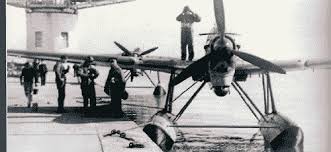 |
| Laté 298 - A very slim bomber ! |
The fuselage became slim with an inverted ovoid section and the wings became quite triangular.
The Latécoère 298-01 prototype, was completed the Mars 31, 1936.
She was an all-metal monocoque of 12.5 m long, weighting about 3,000 kg empty and 4,550 kg at take off.
Her wings had a span of 15.5 m with an aspect ratio of 7.6 and an area of 31.6 m².
The maiden flight occurred the May 8, 1936 with a Hispano-Suiza 12 Ycrs engine - amazingly devoid of his cannon - and delivering 860 hp.
During the trials, a top speed of 287 kph at 1,500 m was quickly demonstrated as a climb to 2,000 m in 7 minutes (285 m/min or 940 ft/min).
The service ceiling was 5,100 m.
Her floats contained tanks containing 1,110 liters of fuel, allowing an usual total range of 1,000 km.
The marine and flying qualities and the performances were outstanding, but the cockpit was found wanting:
- The emergency exit from the plane was extremely difficult;
- The visibility appeared poor.
So, a complete redesign of the cockpit occurred, induced a loss of fineness of several kilometers per hour.
 |
| Latécoère 298 in action. The torpedo was launched at about 100 m above the sea level... |
Several orders totaling more than 175 Laté 298 were given.
The definitive engine was Hispano-Suiza 12 Ycrs delivering 880 hp at 1,500 m.
For these series seaplanes, the take-off weight varied from 4,360 kg to 4,800 kg following the chosen mission.
Nevertheless, with a fixed pitch air-screw, the take off weight cannot exceed 4400 kg.
As the propeller was often upgraded since the beginning of the trials, the performances have progressed.
The top speed was 295 kph at 2,500 m.
The fast cruise speed was 270 kph and the economic cruise speed was 245 kph.
The climbing to 2,000 m needed 6' 33" (305 m/min or 1,004 ft/min).
The service ceiling was close to 6,000 m.
A diving speed of 430 kph was measured in 1938.
The armament comprised 2 forward firing Darne riffle caliber machine-guns ans 1 rearward firing similar weapon for the gunner.
For recce missions, the torpedo was replaced by a 535 liters tank, allowing a total range of 2,530 km.
{An easy aerodynamic cleaning of the Latécoère 2398 was possible, with a better design of the belly part of the bow of the fuselage (just in front of the torpedo, as it was done later for her terrestrial variant Laté 299) and of the radiators, with rearward exhaust pipes.
An idea of such refining of the fore part of the fuselage is given by the Laté 298 E.
This up-grading of this floatplane, combined with a higher critical altitude of the engine, could achieve a significantly better top speed (~ 320 kph).}
War operations
The torpedo gun-sight was a Levasseur 7 b-1 which was a relatively complicated device gathering a semi-circular external rail, a mobile sight moving on this rail and an analogical calculator giving the heading and the time to launch the torpedo.
The trials of the Laté 298 were very comprehensive, this explaining why the Aéronavale crews encountered few problems.
The performance gap with the previous aircrafts leaded, nevertheless, to some incidents or, alas, to accidents.
The torpedo launching might be done up to 300 kph and 80 m above the sea surface.
The 400 mm DA torpedo weighted 674 kg, might reach a warship at 2,000 m when using a speed of 44 knots (at 3,000 m, using a torpedo speed of 35 knots).
The torpedo hit its target in 90 seconds in the first option and in less than 3 minutes in the last one.
The explosive charge weighted 145 kg of TNT.
Because I strongly doubt about the capacity of the crew to adjust the speed of the torpedo during the flight, it is likely the choice of the speed was a function of the accuracy (= the training) of the pilot.
A very experienced pilot might be able to launch safely his torpedo at 3,000 m, avoiding most of the AA defenses.
CC (Lieutenant commander) Jacques Lamiot was commanding the T2 squadron since September 1938.
At the Spring 1939, his unit received the Laté 298. He described these aircrafts (in Icare #61) as the (actual) best torpedo-bomber seaplanes of the world:
"They were maneuverable as fighters, rather fast as seaplanes, they might take off wonderfully in bad weather.
We were at the fleet service to launch torpedoes on enemy targets, to create a smoke screen to hidden our boats or to obtain an accurate idea on the enemy moves."
Two squadrons of Laté 298 were allowed to Admiral Abrial who were in command of the naval forces in the North of France.
At this time, nobody among the high ranking naval officers of this staff was confident about the military efficiency of these torpedo-bombers.
So, they exacted a torpedoing trial on one submarine chaser.
Two Laté 298 launched their torpedoes which hit the chaser quite simultaneously.
Now aware of the value of this unit, the staff demanded the aircraft to fly intensively, without care about the meteorological conditions, even if, flying just above the sea surface with a poor visibility, they had very few chance to discover enemy vessels.
That was a true change for the crews, more accustomed to fly above the Mediterranean Sea!
The pilots of this unit became quickly able to fly in any kind of weather.
Unfortunately, the other torpedo-bomber units were never submitted to such a good training, this explaining big problems in June 1940.
A pin problem to initiate the Phoney War
At the very beginning of WW II, some soldiers were not all in an real war mood: They were not instantly ready to kill their enemies.
That was of the responsibility of a lot of French politicians who used always of pacifist speaking.
That explain the problem of two crews of the T2 (Torpedo-bomber squadron #2) who, observing a thin wake on the sea surface, interpreted that as the wake of a periscope, obviously belonging to a German U-Boat. They had warned their naval HQ.
Nevertheless, the staff of the admiral was angry against these men who had not launched their torpedoes on this submarine.
These men explained first that it was technically impossible to hit a submarine with a torpedo programmed to run at a 3 m depth.
They added also that a security pin blocked the detonator (to avoid any lethal accident).
One may understand the novelty of managing a squadron of torpedo-bomber. They were pure sailors accustomed to guns, shells, propulsive charges, rangefinders, radio, even air-screws.
In all the cases they lived, they were able to solve themselves such a insignificant problem.
Nevertheless, this incident was a strong signal of the low level of peace-time reflections about the offensive recce tactics.
The staff was absolutely right to want their seaplanes permanently able to destroy any encountered enemy target.
But, during the peace time, a abnormal amount to time was wasted by the high ranking officers about the number of battleships needed for the Combat Group...
Anyway,the deciders thought the presence of the pin during a war flying denoted a complete lack of war spirit!
So, the commanding officer of the Aéronavale in the North of France was fired.
After what, the Laté 298 carried often two 150 kg armor piercing bombs to destroy battleships.
When they carried torpedo with a new security device remotely disabled.
{One may wonder why these missions were not carried by a pair of floatplanes, one carrying bombs to destroy submarine the other one carrying a torpedo to attack warships.}
War operations
The Latécoère 298 of North-West of France were based either at Boulogne or at Cherbourg.
From these harbors, they escorted convoys, patrolled the Channel and the close part of the North Sea.
The Forbidden Mission
Among the most infuriating decisions of the French naval deciders during this first year of WW II, was the refusal to involve these excellent seaplanes in the Battle of Norway.
Such a decision was amazing, taking into account the numerous ships and troops sent by the French Navy:
- Two cruisers (Emile Bertin and Montcalm),
- Nine destroyers (Bison, Tartu, Maillé Brézé, Chevalier Paul, Boulonnais, Milan, Épervier, Brestois, Foudroyant),
- Seventeen troop transports (Ville d'Alger, Djenné, Flandre, Président Doumer, Chenonceaux, Mexique, Colombie, Amiénois, Saumur, Cap Blanc, Châteu Pavie, Saint Firmin, Albert Leborgne, Paul Émile Javary, Saint Clair, Vulcain, Enseigne Maurice Préchac),
- at least 2 submarines (Rubis and Casabianca) forgotten by the English Wikipedia but told us by Captain Blanchard - who was officer inside the Casabianca submarine during this Battle - in his book about famous Captain Jean L'herminier, who later escaped the Toulon scuttling in November 27, 1942 with the same submarine, to join th Free Frenchs and participated gallantly to the liberation of Corsica in 1943).
The British Admiralty used of many of the planes of the Fleet Air Arm with which their crews fought gallantly and efficiently.
Obviously, the German terrestrial bombers and seaplanes were fully involved in this Battle to help their ships and their soldiers.
They successfully acted against our ships. One of these loss was the Bison destroyer, sunk the May 3, by a Stuka wrongly (to my opinion) identified as a Junkers 88, an aircraft absolutely inefficient at that time, which was hated by her crews until heavy modifications occurred.
The French destroyers were based at Scapa Flow.
The Lioré et Olivier 258 floatplanes could also have been useful for this campaign and share the same base, at no more than 500 km from Stavanger.
The Laté 298 could either share this base with them or, even better, be based in the Shetlands. From this base, they were at only 350 km from Bergen.
Auxiliaries of the French infantry!
The German Fall Gelb of Guderian and von Manstein gave them a chance to fight... the German tanks!
The May 21, 1940, the Latécoère 298 were sent toward the Somme estuary to destroy German armored columns with their 3 riffle caliber machine guns and two 150 kg AP bombs, normally used to pierce the armored deck of battleships!
They did not found these columns, but the German Flak was there.
However, while they flew back, in the vicinity of Dieppe, they discovered a lot of German bombers ready to release there bombs one the city.
Confident in the fighter capabilities of their nimble seaplanes, the pilots already attacked the German bombers which fled already!
Jacques Lamiot told us, 32 years later, that, at this precise moment, the French aircrafts were firing with their rather weak machine guns from distance. Likely, they, could not damage them seriously.
Nevertheless, the German pilots feel themselves in danger.
Protecting the towns was really one typical mission allowed to fighter planes, and the nimble Laté 298 succeeded this way...
Go I know not whither and fetch I know not what
The May 23, the twelve Latécoère 298 of the T2 squadron were again sent to destroy an armored German column somewhere between Abbeville and Boulogne-sur-Mer.
Obviously, nobody was able to say where were the Allied troops nor where the enemy columns.
Lamiot, taking into account this odd situation, divided his squadron in three waves of four Laté 298 each.
The first wave (the one led by Lamiot) rummaged the whole 70 km long zone between the two cities without any success.
Nevertheless, when they flew back to home, at an altitude of only 1,000 m, they were under fire of a Flak battery installed on the summit of a hill.
At the precise moment they were about to destroy this battery, they were attacked by several Messerschmitt 109 E.
Three Laté 298 were downed, the last one succeeding to escape, her gunner being KIA.
The two other waves received more accurate informations, so they succeeded their missions and return at home without problem.
During the Dynamo operation, the Latécoère were only used for reconnaissances or to transport VIP.
Unfortunately, one of them was shot down by a French submarine chaser which succeeded to rescue the crew.
This chaser has been machine gunned juste a while before.
Nevertheless, such a friendly fire demonstrated the poor quality of the training of the officers who was in charge of commanding the fire : They were note able to discriminate the friends from the foes!
Some days later, the June 6, a operation was decided to destroy a bridge at night near the town of Saint Valéry. Unfortunately, the bridge embedded in a fog was not founded.
However, the crew were witness of the mighty artillery preparatory artillery bombardment which was the initial phase of the Somme and Aisne German offensive. At their arrival at home, they already informed General in Chief Marcel Weygand.
Toward the Italian front?
Just after that, the Latécoère 298 squadrons were withdrawn from the North of France with no clear orders, as if the only one order was : "Fly Southward"! So, it resulted a dramatic disorder.
Among the numerous problems the crews experienced, they have no map at all for any aerial navigation over France. So, several crashes occurred.
{The June 15, 1940, the general-to-be Stehlin, actually commanding officer of the Groupe de chasse III / 6, was driven to cut the map of the West Mediterranean Sea in a primary school book of Geography to be able to lead his 25 Dewoitine D.520 from Perpignan to Algiers! in Témoignage pour l'histoire, Paul Stehlin}
The June 19, while his T2 squadron was flying toward Algeria off the Balearic Islands, Jacques Lamiot find out an Italian submarine sailing un-submerged. The squadron attacked with their bombs but the submarine had already submerged.
It's likely the submarine was damaged because a LéO 257 bis of the B 2 squadron, flying over the same position, one hour later, reported a large oil puddle.
The day after, while flying between Bejaïa and the Mellah lake (close to the El Kala town) another Italian submarine was seen 100 km North of this position and attacked by the last armed seaplane.
Unfortunately, the bomb did not explose.
From the other hand, the weather became very bad, with continuous storm line and the proposed torpedo attacks were not launched.
Such failures might be attributed to the lack of training in bad weather conditions of the units attributed to the Mediterranean theater
After these events, the Latécoère 298 seem to have been devoid of torpedoes!
That was very fortunate for the British H force sent by Winston Churchill to destroy de French fleet harbored at Mers El Kebir, the July 3, 1940.
Knowing - now - the great deficiencies affecting the HMS Hood battle cruiser, a simple torpedo hit could have been disastrous at this moment, transforming this apparent victory in a huge political defeat.
But that highlight also the political cowardice of the French naval deciders, who had not attacked the Kriegsmarine in Norway nor the Regia Marina in the first days of the Italian offensive against France.
So, they did not attack the Royal Navy when it was shooting their warships.
General de Gaulle, infuriated by this surprise attack which became a source of considerable problems for recruiting Free French soldiers and officers, said to Churchill how he was disappointed that no one British vessel was sunk (in De Gaulle, Mémoires de Guerre, I, l'Appel).
Epilog
French naval pilots liking very much these Latécoère 298, wanted to have them anywhere.
There was some interesting developments conducted in several directions.
Pierre Latécoère asked engineer Moine to derive a terrestrial variant of the Laté 298 for use on an aircraft carrier as the Laté 299.
However, the deciders actually wanted two-engined torpedo-bombers for the two new aircraft-carriers Joffre et Painlevé and exacted a speed of 360 kph.
These two aircrafts were the SNCAO 600 (from the Nieuport staff) and the Dewoitine 750.
It was a good conception to minimize the rate of losses - having 2 engines may allow to return home more safely - as also a bad conception because each of these multi-engined aircrafts required a very similar amount of space than the Laté 299. With a very larger cross section (about 3 times more than those of the Laté 299), they had no chance to be significantly faster.
 |
| CAO 600 - A rather complicated shape induced by the multiplication of balconies. |
The best of the two-engined bombers, the CAO 600 had excellent flying capabilities, but her top speed did not exceed 380 kph.
The total range was significantly reduced.
The layout of the Laté 298 was modified in order to give a normal position to the gravity center of the aircraft, owing the floats suppression.
The top speed after the early trials was 345 kph at an altitude of 1,500 m.
When fitted with exhaust pipes similar to that of the Dewoitine 520, the top speed increased to 356 kph at an altitude of only 1,500 m.
The climbing time for 4,000 m was a bit more than 10 minutes (a time of 11'30" was released, but the time excess was caused by an overload of 145 kg, acknowledged later).
For the French Navy, the success of the Laté 299 was obvious, so the aircraft was ordered, but too late, at the time of the Franco-Britannic defeat of June 1940.
However, if they had been built some 3 years earlier, these terrestrial torpedo-bombers, faster and more nimble, could have create numerous problems to the Germans and all their partners.
During the 1947 year, the Latécoère company was asked to study the construction of a new variant of the Laté 298 floatplane fitted with the German Jumo 213 engine, delivering 1,730 hp.
With such a powerful engine, the estimated performances would have been clearly boosted.
The expected top speeds were:
The economic cruise speed was 296 kph at 2,500 m.
The ceiling was 8,500 m.
The total range was 780 km.
The project was submitted in April 1948 but was not proceeded with.