Showing posts with label naval aviation. Show all posts

Sunday, January 26, 2020

The Mitsubishi G3M bomber (Nell): A very powerful naval warfare concept ( Modified the March 30, 2022 )


An original war concept


In 1933, the Japanese Imperial Navy published a very original program for a strike airplane with a very large combat radius.

The method invented for the proposed actions was original as, also, very daring

  • The new torpedo-bomber was supposed to attack, with torpedoes, enemy boats very far from the Japan.  
  • Thereafter, to save the crew, if no station was rapidly available, the only solution was to ditch the torpedo-bomber nearby a Japanese submarine (supposed to be already in the good place).

Obviously, the Japanese Navy expected at least two advantages from this warfare :
  • A total surprise affecting all the attacked sailors.
  • The deployment, by the surviving warships, of huge aerial and maritime recce means became necessary to avoid a new surprise. That imply also to detect the starting point of the offensive. Such a precautionary phase would induce a very carefully (= very slow) progression of  the enemy forces. 

Design


To obtain such a result, the Mitsubishi company conceived a bomber involving the most up to date conceptsShe gathered:
  •  a very slim and streamlined fuselage (externally rather similar to a torpedo), 
  • her wings allowed easy take off with maximum charges
  • the landing gear was almost totally retractable
  • and the cockpit as also the combat positions were really well streamlined.

If Wikipedia tell us this bomber was inspired by the Douglas DC 2, I'm sure she shared a very important part of the Dewoitine D 33 record breaker blueprints that Mr. Emile Dewoitine had sell to Mitsubishi in 1933 (with also, may be, some informations about her military relatives, the D 337 and D 420).

The new bomber was designated as the G1M.

She was 15.83 m long, weighted 4,775 kg, empty, and 7,000 kg for take off, with a 5 men crew.

The wingspan was 25 m and the wing area totaled 75 m², demonstrating an aspect ratio  of 8.33, favoring fineness and, thereby, total range.

The wing loading of 93 kg/m² - as also the Junkers Doppelflügeln system - allowed easy take off.

Unfortunately, if the 12 cylinders in W liquid cooled Hiro type 91 engine delivered the announced power of 650 hp, that was only at sea level: The absence of supercharger interdicted to maintain such amount of power at altitude.

The G1M flew first in April 1934.

Twenty-one preseries examples of this bomber were built and used in numerous (and hard) experiences.

The top speed was 266 kph at sea level. It was soon totally insufficient if they were facing all the fighter prototypes of the times.

The service ceiling was 4 500 m.

From the other hand, the bomber structure appeared as not very tough.


Fortunately for the Japanese Imperial Navy, some brand new radial air-cooled and supercharged engines appeared in Japan at this moment, and among them, the good Mitsubishi Kinsei.

The Imperial Navy ordered a new bomber taking into account the shortcomings of the G1M, so Mitsubishi answered with the G3M.

The fuselage was lengthened to 16.45 m, the wings remaining unchanged.

The take off weight was now 7,700 kg.

The maiden flight occurred in July 1935.

Two Kinsei engines delivering 910 Cv were used, and the to speed became 350 km/h at 2,000 m.

The service ceiling increased from 4,500 m to 7,500 m.


Mitsubishi G3M - Close from Nanking, 1938


The G3M was ordered for the production of about 30 examples for 1936 (G3M1). 

The mass-production of a more powerful variant - the G3M2 - began in 1937 and was running until 1939. 

The crew of this bomber increased to 7 men, taking into account the enhancing of the defensive armament.

A first set used Kinsei 42 engines delivering 1,075 hp at take off and 990 hp at 2,800 m. 

The second set used Kinsei 45 delivered the same power for take off but had its critical altitude 1,000 m higher. 

This variant hat a top speed of 375 km/h at 4,200 m.

She had a service ceiling of 9,100 m and a total range of 4,300 km.

700 bombers of this variant were produced.


The last variant, designated as the G3M3, had engines delivering 1,300 hp for take off and  1,200 hp at altitude. 
The top speed was 416 kph at 6,000 m. The service ceiling was 10,000 m.

More than 200 examples were produced from 1939 to 1941.


The defensive armament, initially, gathered only 3 rifle calibemachine-guns; It was later enhanced either by adding a simple machine gun, or by a short 20 mm cannon of the MG FF F type.

In all cases, the maximum bomb load was limited to 800 kg. 

The type 91 Mk 1 torpedoes weighted more than 780 kg including 150 kg for the explosive charge.


Japan used also this bomber (devoid of armament) for propaganda tours, as shows the below photograph.


Mitsubishi G3M2 during a propaganda tour in the USA  in 1939: A very clean external finish.


In 1941, the G3M production was stopped because the G4M began to equip the IJN bomber groups.


In action 


The G3M (Nell in the USA) went to war at the end of 1937, during the Sino-Japanese war.

Taking advantage of their huge combat radius, they were used for the bombing of coastal target near Shanghai (this implying to cross, during some missions, about 700 km of the Japanese Sea).
These bombers were involved also in the 24/24 bombing of Chongqing.

Even they were protected by Imperial Army and Imperial Navy fighters, they often had to face Chinese fighters of the Kuomintang Army (whom leader was Chiang Kai-shek), which were mostly of soviet origine (Polikarpov I 15, I 15 bis, I 153 et I 16).

That bomber was not more armoured than her successor, the G4M (Betty), but she was clearly more slim, implying a weakening in the accuracy of firing by the attacking fighter or the AA guns. 

Nevertheless, in 1941, the staff officers of the Imperial Japanese Navy thought this bomber was already obsolete.

But, since the beginning of the Pacific War, Japan need to use of all the existing bombers, including the G3M. 


The Decembe10, 1941, the powerful British fleet dubbed Force Z, a fleet gathering the so-called "up to date" battleship HMS Prince of Wales and the battlecruiser HMS Repulse, escorted by the destroyers ElectraExpressVampire and Tenedos, was in the Malaysian waters, in order to deter a Japanese disembarkment in this country.

In fact, the Allied forces were deceived by the IJN forces. The Force Z was instantly tracked by I-65, then by I-59 IJN submarines, as also by IJN recco floatplanes launched by cruisers of the IJN fleet.

When Admiral Tom Phillips left Singapour, he felt immediately in an ambush. 

The combat initiated at 11:00.

Sixty G3M2 based in Saigon (in the then French Indochina) divided in two groups. The first one gathered 35 bombers. .

These bombers launched heavy bombs from high altitude (often said to be 3,500 m, but  actually clearly higher, likely near 5,000 m as suggested by the personal diary of sub-lieutenant Albert Jacobs). 
While the first group was creating an intense diversionary tactic, the group gathering the remaining G3M2 launched torpedoes. 

The HMS Prince of Wales was hit by the first torpedo which struck the rear port part of the hull, near the outer port screw. 

Initially, the damage was underestimate, but it was catastrophic: The steel shaft moving the screw had been totally bent by the explosion, opening numerous waterways in the different sealing partitions.

Then, there was no more electricity in the back half of the ship, inducing the shut down of the water pumps and, consequently, a 11.5° list to port
This interdicted simultaneously the starboard 5.25 inch AA guns to fire against the remaining attacking torpedo-bombers, because the actual elevation of the guns was to strong to hit the incoming sea-skimmer planes.


From the other hand, the HMS Repulse escaped to 19 torpedoes (!), thanks to the outstanding skill of the commander William G. Tennant and to the excellent training of her crew. 
Nevertheless, a bomb hit the battle cruiser, destroying her useless Walrus.

At this moment, 17 G4M1 brand new bombers were attacking the battlecruiser from both sides with torpedoes.
Two of the Betty were downed by the AA artillery fire of the Repulse and 8 were badly damaged.

Alas, the Repulse was simultaneously hit by 4 or 5 torpedoes: At 12:33, this proud fighter capsized with 500 sailors on board.


Six other G4M1 launched their torpedoes on the Prince of Wales: Among them, three had hit the battleship.
One 500 kg bomb completed the disaster. 

At 13:15, the ship abandonment order was given. 

At 13:20, the battleship capsized and sunk with 327 sailors, among them the Admiral Phillips.


In 2007, a visit of the wrecked hull of the PoW by divers demonstrated the first torpedo, the most important one, was less powerful than the last one

The first explosive charge weighted 150 kg (type 91 mod.1 torpedo) launched by a G3M2 (Nell) and the last one, with an explosive charge of 205 kg, was a type 91 model  2 torpedo, so it was launched by a G4M (Betty).


This battle proved the highest deciders of the Royal Navy had not understood the lesson of their own victory against the Regia Marina at Tarento in 1940 and they did not think to the Allied defeat occurred only 48 hours earlier at Pearl Harbor!

However, the Japanese victory was a trompe l’œil one for the IJN, because Admiral Philips refused to involve the Brewster Buffalos of the RAF. 
If Commander Tennant, who warned them, had warned them one hour earlier, even these fighters had a very occasion to down a large part of the Japanese bombers... 

In September 1941, the RN flew the Spitfire V float plane (520 kph at the best altitude) for the first time.
 Some British columnists asked for such sea fighter since the Norwegian Campaign of 1940. 
It was certainly possible to speed up the development of this aircraft, knowing a similar transformation was scheduled in May 1940, using a Spitfire II airframe. 
It was possible to expect at least 500 kph from such a fighter.  

So, with 8 float Spitfire II instead of its 8 useless Walrus (weighting 3,700 kg at take off), the Force Z could have expected a very better fate. 
Such fighters would have focused on the torpedo-bombers which were easy preys for them. 

Everything happened as if it was intellectually impossible for Admiral Tom Phillips to imagine the Japaneses were able to plan such a mighty raid against his own fleet with only a formation of bomber and, above all, without any battleship to support them!

Patently, he had not a good knowing about the RAF experiments with the Cubaroo bomber between 1924 and 1926.

From the other hand, one may also wonder on some other points regarding the Force Z : 
  • The Repulse had 24 QF2 de 40 mm Mk VIII with which she downed 2 bombers and damaged 8 others.
  • With 32 identical cannons, the Prince of Wales achieved no good results. Maybe, the training of the AA crews on board of the PoW was less efficient than on board of the Repulse
  • Even worse, for her AA defense, no destroyer had more than a single QF2 cannon (!); The 12.7 mm machine-guns were useless: They cannot do anything against the bombers flying at 5,000 m.

After such an important victory, the Nell military history was not over 


Obviously, this bomber was an active player in the conquest of Philippines and Indonesian territories. 
But the then amazing weakness of the Western colonialist powers (USA, GB, France and Netherland) gave us a biased picture.

By his own strategic conception, Admiral Yamamoto wanted, at this times, that Japan establish a bridgehead in Australia. 


Darwin and the Bathurst Island are at the North-West of the Northern Territory.


The Darwin attack by the IJN began by an important aerial bombing thFebruary 19, 1942.

This raid have been thoroughly prepared by reconnaissance flights likely done by floatplanes on board of long range submarine cruisers.

The first strike was done by the bombers and torpedo-bombers on board of 4 (Akagi, Kaga, Hiryu & Sôryuamong the 6 carriers which had attacked Pearl Harbor.

The first wave constituted of 81 Nakajima B5N which were in charge of high altitude bombing or torpedoing, and 71 Aichi D3A dive-bombers.

Thirty six A6M2 Zeros protected the bombers but, also, conducted strafing attacks.


The A6 M2 downed first a Catalina flying boat. 


Unfortunately, the
 RAAF guard officers, as usually at this early stage of the war, refused to take into account of the warning of a coast observer (the catholic RP McGrath) who warned them that an important amount of aircrafts in the sky of the Bathurst Island, heading  South at 09:35. They interpreted these aircrafts as Allied going back from Indonesia.

So, the surprise was complete when the Japanese wave struck Darwin at 09:58...

At this moment, the Darwin harbor housed 65 ships of any purpose among them, many were supporting the Allied forces fighting against the Japanese forces in Indonesia.


Explosion of the Neptuna cargo le 19 - 02 - 1942. The Katooma patrol boat, in the foreground, escaped unscathed.


After 30 minutes of strike, the Japanese bombers - among them 35 were more or less damaged - returned to their carriers. 

They had sunk 11 ships and damaged  numerous others. 

Only one of the ten present P 40 of the USAF escaped the Zeros. The other ones have been downed or destroyed on the ground.

The second wave arrived on Darwin at 11:58. The alarm sirens, this time, gave an effective warning.

The English Wikipedia tell us the Japanese bombers were flying at 18,500 ft (= 5,624 m), but this is the official story telling. 

From the other hand, Bernard Baëza, in his excellent book Soleil Levant sur l'Australie (Lela Presse, in French), indicates the G3M bombers were flying at 8,000 m.

That is clearly more consistent with the total absence of hit achieved by the sixteen 94 mm AA cannons than the official theory of a generalized shell detonator anomaly!

However, the Japanese bombers took the time (nearly one hour) to identify their targets and launch their bombs. 

Such a comfortable situation for the Japanese airmen demonstrate the the British government had never expected the Australian territory could be attacked! 

The aerial base was badly damaged. 

Among the 30 destroyed aircrafts on the ground, there were six Lockheed Hudson, two P 40 and one B 24, reducing again the Australians capacities.

Six members of the RAAF were killed, as ca 250 others in this tragic day.

Wikipedia wrote the huge difference of casualties between the raid on Darwin and the raid on Pearl Harbor was the total absence of battleships. 

It is not so simple: Australia is an almost désertic country in which the life is difficult. In 1941, Darwin was a tiny town with ca 2,500 inhabitants, but, at the same period, Honolulu had 180,000 inhabitants. 

The human density was very weak, this reducing automatically the probability of lethal impacts.
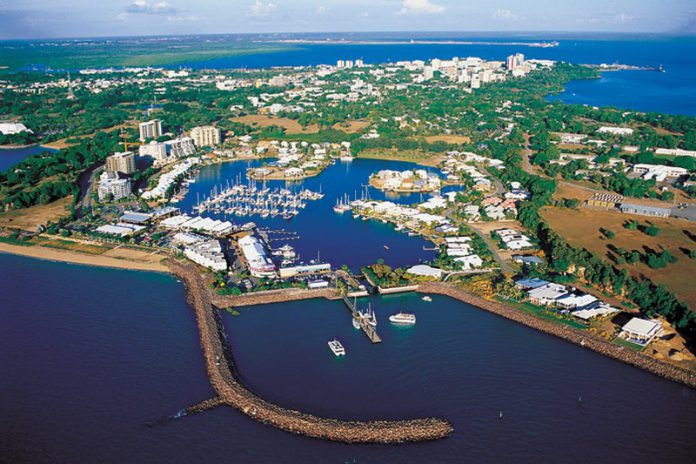


Darwin at the beginning  of the XXIst century


Japanese bombers had dropped 114 tons of bombs, a total of the same order of magnitude than the 133 tons of bombs launched on Pearl Harbor.

A very odd inappropriate order, increasing the terror induced by the mighty Japanese raid, triggered robbery in the houses evacuated by their inhabitants.


This  raid had an immediate effect on the fighting in Java and in Philippines. 

The naval trafic dispersed in other harbors.

Numerous new airfields were built, very well camoufflaged, and USA sent a lot of Curtiss P 40 with their pilots.

The Japanese raids on Darwin continued for almost a year.


The first radar alerts were not very fruitful because the Curtiss P 40 could not climb sufficiently fast toward the flight altitude of the Nell bombers!


A significant change occurred only when Churchill accepted to send Spitfire Mk V which had similar climbing times than the A6M3 Zero fighter.

The first air clash were choking for the British fighter pilots who, initially, thought the Japanese fighters will be easy prey for them. 

So, they experienced a serious disappointment when they discovered the large superiority of the A6M Zeros in dogfight.

But, for the Japanese, the Sptifire was also a bad surprise, because she was faster than all the Japanese aircrafts, including the 600 kph able Mitsubishi Ki 46 (Dina).

The worsening of the combats in the Solomon had the result to push the Japanese threats away from Darwin.

In the following - and last - operational period, the Mitsubishi G3M was restricted to the training role.


Monday, September 9, 2019

Mitsubishi A6M: An excellent fighter, but too predictable tactics...

{This post is the English translation of my post in my French Blog L'Aviation selon Drix }


The Japanese Zero fighter was one of the most brilliant jewels of the Imperial Navy from 1940 to 1943. 

For the Allied, she appeared terrific during at least two years. 

At the very end of the Pacific War, the same people who had been terrified previously, were joking about her : This aircraft disappeared from the air because she is now unable to fight our marvelous new fighters HellcatCorsairMustang and Spitfire.


At the end of 1938, very few were the countries able to use of aircraft carriers (USA, United Kingdom, Japan and France). 

Most of them used only of biplane fightersE.g. the US Navy had the Grumman F2F (372 kph) and F3F (425 kph).


Grumman F3F1 : the engine was 1.38 m in diameter, delivered 950 hp, the fuselage was short (7 m), the wing area totaled 24 m². Despite a lethal crash after only 10 days of flight testings, a flat spin induced the loss of the second prototype (without injury for the pilot). This fighter was produced and inspirited the  F4F Wildcat.


The Fleet Air Arm, in the best case, used of the Sea Gladiator (395 kph), in the other cases, it used the Blackburn Skua, a good dive bomber with a top speed of 

Nothing about the Kriegsmarine because the Graf Zepplin carrier would be certainly able to carry the modern Bf 109 T as, also, the terrific Junkers 87 Stuka dive bomber. She never achieved the last steps of her development, even she was already afloat in 1938
Hermann Goering refused to give aircrafts for "that"...


The French Navy was never interested by the biplane fighters, except at its very debuts (Hanriot HD1 / HD2). May be that was only to appear more advanced than the others navies...

The last parasol fighters (Dewoitine D. 373), were claimed fast (405 kph), but they never exceed 380 kph.


However, with the Mitsubishi A5M, the Imperial Japanese Navy was the first Navy to may use of low wing monoplane fighters

The A5M was 7.57 m long, weighted 1 220 kg empty and 1 670 kg at take off.

The wingspan was 11 m and the wing area totaled 17.8 m² giving a wing loading of 94 kg/m².


A5M - The 785 hp engine was  1.28 m in diameter (0.13 m larger than the engine of the Zero.


Achieving 440 kph, climbing to 3 000 m in 3' 35" and having an exceptional maneuverability, she triggered the obsolescence of all the on-board biplane fighters. 

The Imperial Japanese Army top staff manipulated very easily the rulers of its country. 

Its deciders seemed to imagine for themselves a planetary role. But the following events demonstrated they did not have a true knowledge in the geography of the coveted regions nor in their adversaries. 

This heralded tomorrow who are disillusioning. 

The  Imperial Navy, feeling the coming crisis, was to prepare its future playground: The Pacific Ocean, the Indian Ocean and all the connexions between them. About the third of the Earth area...    


At the beginning 


 Since the 1921 experiments of Billy Mitchell, each people sharing some common sense knew the battleships were simultaneously excessively expensive and, also, quite inefficient

In December 1941, the US Navy go to war with the 7 following aircraft carriers.
  • Lexington (CV-2 1927)   -  37 000 tons and 90 aircrafts 
  • Saratoga (CV-3 1927)    -     37 000 tons and 90 aircrafts 
  • Ranger (CV-4 1934)      -  15 000 tons and 60 aircrafts   
  • Yorktown(CV-5 1937)     -  20 000 tons and 70 aircrafts   
  • Enterprise(CV-6 1938)   -  20 000 tons and 70 aircrafts   
  • Wasp(CV-7 1940)         -  15 000 tons and 60 aircrafts   
  • Hornet(CV-8 1941)       -  20 000 tons and 70 aircrafts   

I omitted the Langley (CV-1) she was only used as a lorry transporting essentially aircrafts in crates. 

Most of the american dive-bombers were the very inefficient Chance-Vought SB2U Vindicators (known in France as the Chance-Vought 156) which seemed designed only to give victories to the Axis pilots. 

The Douglas torpedo-bombers TBD Devastators, even rather slow (335 km/h) and not very maneuverable, were able to sink enemy merchant boats as also the aircraft-carrier Shôhô

The best, these US carriers were able to create an aerial attaque force gathering 500 aircrafts. 

Some stay in the Atlantic Ocean, but the Panama Canal was firmly held by USA, reducing the chances of a blocking of their fleets. So, they might transfert at will their aircraft-carriers from one ocean to the other (it's no more possible today, taking into account the too large size of the nuclear carriers).


The Imperial Japanese Navy obtained, in the Washington agreement (1921), the third rank in the World, equal to the sum of the French and Italian Navy.

The December 6, 1941, it gathered 11 carriers :
  • Hōshō (1921)    -    8 500 tons and 15  aircrafts   
  • Kaga (1921)     -  32 000 tons and 80  aircrafts   
  • Akagi (1925)    -  31 500 tons and 60  aircrafts 
  • Ryūjō (1931)    -  10 500 tons and 45  aircrafts  
  • Sōryū (1935)    -  16 000 tons and 60  aircrafts  
  • Hiryū (1937)    -  17 500 tons and 60 aircrafts  
  • Kaiyō (1938)    -  13 500 tons and 24  aircrafts  
  • Shōkaku (1939)  -  26 000 tons and 70  aircrafts 
  • Zuikaku (1939)  -  26 000 tons and 70  aircrafts 
  • Zuihō (1940)    -  11 500 tons and 30  aircrafts 
  • Shōhō (1941)    -  11 500 tons and 30  aircrafts .


    These carriers totaled 544 aircrafts for the Pacific Ocean and the Indian Ocean .


    Most of them (circa 80%) were either Aichi D3A (Val for the US) dive bombers able to fly up to 390 kph or torpedo-bombers Nakajima B5N (Kate for the US) which had a top speed of 380 kph.

    It's must be added a large amount of float planes carried by heavy cruisers, by submarines and by seaplanes tenders. 

    Most of them were dedicated to recce flights.


    The Octobe5, 1937, the high staff of the Imperial Navy published, for the Zaïbatsu (=Japanese trusts)  Nakajima and Mitsubishi, a program gathering its needs for a new on-board fighter which was to be powered by an actual running engine. 

    This last point, as also the very hard level of the specifications, demonstrated the Empire of the Rising Sun was about to go to war with the Allies
    • The top speed must achieve 500 kph at 4,000 m.
    • Climbing to 6, 000 m in less than 9' 30".
    • The total range must be 2 hours at full speed (=1 ,000 km) and from 6 to 8 hours at the economical cruising speed 
    • Two 20 mm cannons and two 7.7 mm  machine guns were needed.
    • The flying qualities and the maneuverability were to be equal to those of the previous A5M.
    • A very complete radio equipment must be found in each fighter, including a goniometric receiver.

    The design staff of Nakajima refused so hazardous a work. 

    But Jiro Horikoshi, chief of the design staff in Mitsubishi, accepted the challenge. He was helped by a special alloy combining magnésium and aluminium found by the Sumitomo industrial group (this alloy implied special protections against corrosion).

    The Mitsubishi Zuisei engine was chosen for the first prototype, because its low weight
    Il delivered 780 hp in altitude, allowing to reach the specified 500 kph speed.

    Nevertheless, the climbing times being only average, it was substituted by the Nakajima Sakae engine delivering 925 to 940 hp and allowing performances well above the expectations.


    The very advanced technology of the new fighter implied a very thorough production.


    Mitsubishi A6M2b - A very streamlined fighter.


    The A6M2b Zero in December 1941     

    The fuselage was 9.05 m long.

    She weighted 1,754 kg empty and 2,421 kg for take off (normal payload = 665 kg). 

    Overloaded (drop tank + two 60 kg bombs), the Zero took off at 2,800 kg.

    The wingspan was 12 m and the wing area totaled 22.44 m², quite identical to the one of the Spitfire Mk I (22.48 m²) that was 204 kg heavier. 

    The relative thickness of the foil varied from 15% at the roots 9 at the extremity.

    The aspect ratio was 6.42 (5.61 for the Spitfire Mk I), an help to the obtention of good performances.

    The wing loading was 108 kg/m² allowed her the extraordinary turning capability which established her an unparalleled reputation until today. 

    Overloaded (max fuel+ max bombs), the wing loading don't exceed 125 kg/m².


    The armament gathered two 20 mm cannons (60 shell each) and two 7.7 mm machine guns (700 cartridges each). 

    However, the chosen cannons (Oerlikon 20 mm FF F) were picked for their low weight (24 kg each). So, they had a muzzle velocity of only 600 mps, implying non optimal ballistic properties.

    One may add two 30 kg bombs or, better, two 60 kg bombs, lethal for any destroyer and dangerous even for an cruiser!


    The Nakajima Sakae 14 cylinders engine delivered 940 hp at 4,200 m. 
    Weighting circa 530 kg, having a diameter of only 1.15 m, it had a frontal area of only 1.039 m² which, associated with a well streamlined cowling, explained the good performances and the maneuverability of the Zero

    The fighter displayed excellent performances : 
    • The top speed was 535 kph at 4,700 m, similar to that of the French Dewoitine D 520 fighter in May-June 1940. That speed was also similar to that of the P 40 furnished to the British as the Kittyhawk I for the June 3, 1942, which climbed to 6,000 m in a deplorable time comprised between 14 and 17 minutes!
    • She climbed to 6,000 m in 7' 27" (for the same altitude, the time was 7' 47" for the Nieuport 161 of 1936 but the N 161-03, at the end of 1938, climbed in 7' 03"). Anyway, the Zero outclassed completely the Kittyhawk I as, also, many other Allied fighters. 
    • The VNE of the A6M2 was 630 kph, 70 kph faster than the Curtis H 75 of the l'Armée de l'Air in May 1940.
    • The total range on the intern fuel only was 2,222 km. With the addition of a 333 liters drop tank, the total range was 3,350 km
    • The combat radius, clean, exceeded 700 km if a 30 minutes combat was needed. One may conclude that such capabilities, six times better than those of the Bf 109 astray somewhere in the sky of England, constituted the key of many surprises!
    • The structure of the Japanese fighter implied the wings were assembled in one unique part, helping to obtain a low weight together than a good strength. So, the maneuverability and the performances were favored. However, the construction of the Zero fighter was more time consuming.


    Flying qualities 


    An US report of 1943 gave us some useful informations.

    The cockpit was described as really easy to use. 

    Instruments were easy to read, but the flight stick was positioned forward a little too much, inducing contacts with the dashboard.

    The pilot visibility was seen as excellent, contrasting with memories of a ancient Japanese pilot which lamented about the too fast yellowing of the cockpit canopy Plexiglas.

    During the at the beginning of the take off, the fighter was not easy to keep rolling straight until circa 40 kph, owing to the erratic action of the brakes.

    Above this speed, the ruder became perfectly sufficient to control the direction. 
    Once, however, the fighter had done a severe swing to the left. The recovery was made by using a full last of the throttle and full right ruder. 
    The Zero responded instantly and take off once the direction control was regained.

    The take off was obtained at 120 kph. The optimal climb speed was 140 kph IAS. 
    The angle of climb was very steep and the excellent zoom rate of climb was the best asset of this fighter.

    Up to 500 kph (which see), the Zero was easy to fly, she responded readily to changes in the controlsFaster, the pilot needed both hands to perform a slow barrel.

    The Zero was much less stable in flight than the heavier US fighter, nevertheless, this lack of stability was nullified by the extreme ease of handling.

    The stall occurred at 105 kph clean and at 93 kph with flaps and landing gears extended. 

    The fighter gave ample warnings (by slight buffeting in the elevators and vibrations in the fuselage) before the occurrence of the stallIn all cases, recovery was rapid and straight.

    All aerobatics were easy to perform, and were obtained "with a natural grace, characteristic of the good fighter planes". 

    In particular, loops and immelmans might be performed at indicated speeds as low as 260 kph.

    At the cruising speed, in level flight, it was possible to  carry out consecutive loops without losing altitude.

    The turning radius was very short (the French ace Pierre Clostermann, in his book Feux du Ciel, gave a time 10 to 11 seconds for a 360° turn at cruising speed). The roll rate was fast under 400 kph.

    The landing speed was 135 kph (clean), and, with all extended, the Zero was easy to land at  110 kph. 


    Some words of the most famous Australian ace on the Zero

    Clive "Killer" Caldwell wrote in 1943 (see picture below) that the loss of maneuverability of the Zero appeared at 560 kph (350 mph). 

    According to the exceptional technical and military qualities of this pilot, I'm retaining his opinion.


    Les conseils de C. K.  Caldwell  aux pilotes Alliés - Le Zéro restait manœuvrant jusqu'à 560 km/h !
    Personne n'en voudra à ce pilote de préférer le Spitfire,  là on est dans le pure domaine de l'affectif.


    Pierre Clostermann, in his book Feux du Ciel (Flammarion, 1951, in French) wrote one of his teammate in 1945, the Australian pilot Bay Adams, reported him a combat he had supported the July 6, 1943 with the RAAF in the sky of Darwin, Australia.

    Japanese raid of 27 bombers escorted by 21 Zeros was intercepted by 24 Spitfire which already attacked the bombers, downing about ten of them. 

    Already, they were attacked by the escorting Zeros. 

    Bay Adams launched the charge at 500 kph behind a Zero which flew gently downhill and open the fire. 

    Already, the Zero performed a perfect loop  with a radius of 200 m, being in the six hours of Adams. 
    The Australian pilot, flabbergasted, had instinctive reflex to dive vertically from 7 000 m up to the sea level, saving his precious life.

    This day, 2 Zeros were downed at the cost of 7 Spitfire!


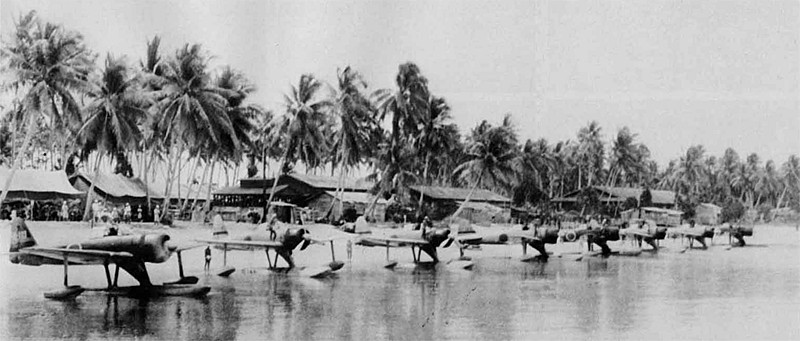
    The A6M2-N (Rufe in the US), the "too late" spin off  floatplane fighter 


    As I wrote previously, the Japan seemed, already in 1937, expected a war with the Americans and their Allies: The will to obtain a great amount of seaplanes constituted an obvious demonstration. 

    OK, a seaplane may took off (or land) theoretically from any water area. 

    Such hydro-bases are, obviously, immune to any form of bombing and, moreover, because, in the entire Pacific zone, there are a huge quantity of islands with a lagoon.

    Each lagoon constitute, potentially, both a landing runway as a take off one where the water waves are ever lower than those of the surrounding ocean.


    The expected future seaplane fighter, the Kawanishi Kyofu appeared not easy to perfect, may be due to some too much sophisticated equipment, as, e.g. the contra-rotative propellers

    The thundering success of the Zero fighter in China induced in some officers of the IJN the idea that a temporary but quite instantaneous solution lay in the adaptation of floats to this fighter.  

    This work was given to Nakajima, from a plane of the first series (A6 M11). The engineers chosen the most marine solution, with only one central float (at the cost of circa 20 kph). 

    The armament was the same than the one used on the Zeros that attacked Pearl Harbor: Two FF F 20 mm cannons and two riffle caliber machine-guns (and, eventually, two 60 kg bombs).

    The prototype of this crash program took off for her maiden flight the Decembre 7, 1941. 

    This fighter was excellent, the rudder have been enlarged, with also the addition of a little under it.

    The length of this fighter was 10.24 m because the central float exceeded the air-screw

    The wing area was conserved at 22.438 m² despite an empty weight increased from 1,750 to 1,920 kg. The take off weight was 2,460 kg. 

    The wing loading was 110 kg.

    The top speed was 437 kph at 4,300 m the total range was 1,150 km at the cruising speed of 300 kph.

    The climb to 5,000 m was done in  6' 49" (to be compared to the 4' 30" for 3,000 m and the  circa 10' for 6,000 m of a Wildcat with a 1,200 hp engine - source : Ital. Wikipedia - ). 

    The service ceiling was 10,000 m.

    The stall speed was 111 km/h.


    A6 M11-N - A modified by me from this site.


    This excellent seaplane was mass produced in 327 exemples, an exceptional amount for a seaplane fighter of WW II.

    They entered service in June 1942 (six months too late for Japan).

    They were used as interceptors, as recce planes and also to harass the American little patrolers (as the PT 109 of JFK) which attacked the Japanese merchant ships refueling the soldiers. 


    Eight A6 M2-N about to fly a CAP


    They appeared as good fighters, including against flying fortress (B 17 or B 24)!

    Flying usually in patrol of three planes, they were fearless against the powerful Beaufighter, despite it was 80 kph faster than the Rufe (but more clumsy): See the excellent book of  Bernard Baëza, Soleil Levant sur l'Australie, Lela Presse (in French).

    In the islands where they were assigned, they had few chance to encounter enemy terrestrial fighters that had not a sufficient range.

    So, they do their jobs during all the war. As scout planes, they outclassed the usual aircrafts of the fleet in speed and in agility, which gave them a better survival rate.

    We can be surprised these floatplanes fighters had not been used in the systematic escort of the Japanese convoy of merchant ships.
    However, such an use was likely to much expensive in fuel supplies. From the other hand, we know how flying seaplanes are reserved to very few excellent pilots...

    At the last part of the Pacific War, the Rufe were based in lakes inside Japan. Nevertheless, some of them dared to attack B 29 bombers!!!


    About the Zero evolution 


    As all the well conceived fighters, the A6M2 was modified to take into account the arrival of new enemy fighters. 

    The very famous Spitfire Mk V appeared not as a problem for her during the first encounters in the Australian sky as late as 1943

    One must recall the British fighter was slowed by her huge and unsightly Vokes sand filterSimultaneously, she became heavier: She was not so fast and not so agile than in the European skies. 

    Moreover, in the RAAF, the high ranking officers had no combat experience in the modern war, but some the younger pilots had already survived combats against the Axis in North Africa, so, they knew perfectly what they have to do (e.g. Clive R."Killer" Caldwell).


    A first modification of the A6M was done in 1941, by the cut of the folding wing tips

    Simultaneously, the Nakajima Sakae engine were more powerful, with 1130 hp (much more powerful variants were produced but none achieved maturity). 

    The fighter became the A6M3

    Alone, the new engine delivered an excess of 190 hp (20%) which would have given a significant increase of top speed (568 km/h) if all other parameters remained unchanged . 

    But other
     - necessary - modifications that made the fighter heavier and increased her drag.

    E.g., to increase the destructive power of the actual Zero, the two 20 mm type FF F cannons of were replaced by two type FF S, gaining 150 mps in V0 and firing 100 shells by drum instead of only 60, allowing more precises shots at longer distance. 


    The top speed increased to 544 kph, but the total range was less extended.

    The shorter wings did not hamper the fighter's maneuverability

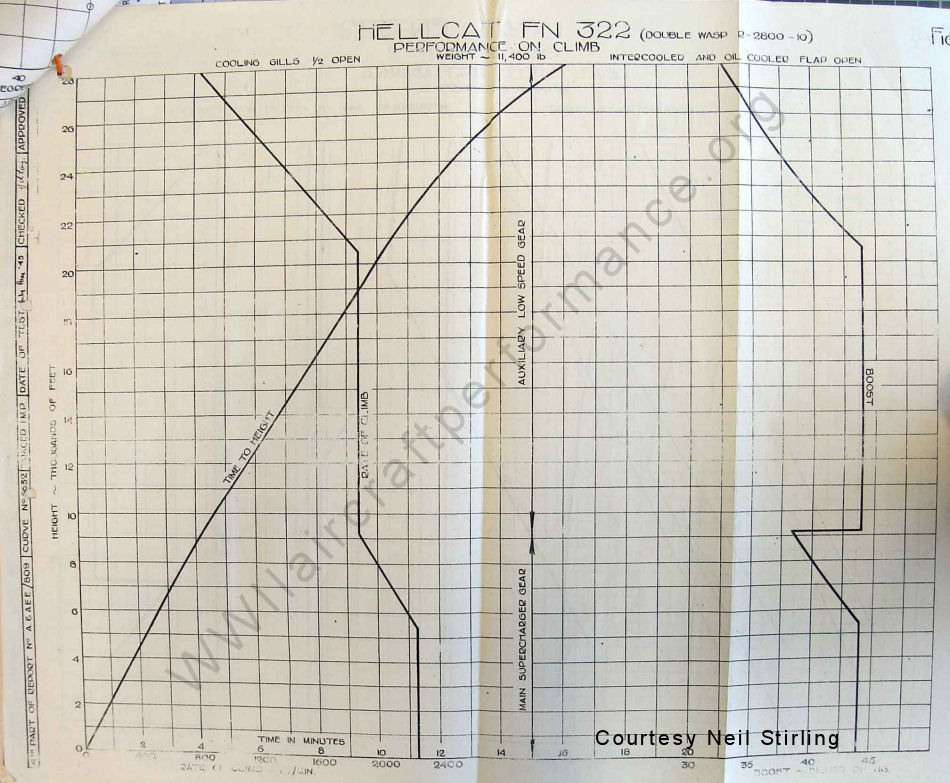
    Once the US Navy had finished the perfecting of the F6 F Hellcat, a bit after the mid-year of 1943, the Zero loose partly her climbing speed advantage. 

    {At first, the Hellcat was conceived to use of the Curtiss 2600 engine delivering 1,600 hp. 
    It appeared clearly under-powered against the Zero, so, the F6 F was fitted successfully with the Pratt & Whitney 2800 engine delivering 2,000 hp. 

    This report on a production Hellcat gave circa 10 minutes to climb to 6,000 m.}


    In the Summer of 1942, the Imperial Navy was convinced the Zero had to fly faster while continuing its refusal of the Kinsei engine(!). 

    A lot of aerodynamic modifications led to the A6M5, including a real armor, the cannons became belt fed, each engine cylinder exhausted backward and the stressed skin of the structure was strengthened to enabled dive speeds up to 667 kph.

    The top speed increased to 565 km/h at 6,000 m to which the climb was done in 7' 00".

    The weight at take off was 2,733 kg, so the wing loading became 128 kg/m², always lighter than those of the Spitfire Mk V (137 kg/m²).

    This was a good - but too late advance - which may had been very useful before the Battle of Midway, by a significant amount of lives of Japanese fighter pilots who could have been saved.


    As you know now, since 1940, Mitsubishi was trying to convince the IJN to use its Kinsei engine in place of the Nakajima Sakae on the A6M fighters. 
    For some never published reasons, this lobbying was never successful.

    However, once the Nakajima plant in charge of producing the Sakae engine destroyed in an aerial bombing by the US B 29, at the end of the 1944-45 Winter, the IJN condescended to began to accept solution of common sense. 

    Despite the desperate aerial situation, the Japanese Navy demanded some tests, those it had ever refused !


    Obviously, these test were perfectly successful, the new Mitsubishi Zéro type A6M8, fitted with a 1560 hp engine (weighting 675 kg), was able to fly at 573 kph, climbed to 6,000 m in 6' 50" and she had a VNE of 741 kph.

    The armament was enhanced by 2 more 20 mm cannons and the replacement of the light machine guns by two 13.2 mm ones.

    Such enhancement may be done to obtain result against the Boeing B 29 bombers, which fly at too high altitude for most of the other Japanese fighters.

    The combat radius was the half part of the one of the A6M2 (the price of the new power!) and the wing loading increased to 148 kg/m² (clearly less than the Allied fighters had). 

    The order of production for 6,300 was published. But too much time had been wasted.
    The minimal amount of this variant which were built were now useless...


    Oversimplified  summary of the Pacific War


    The Starting Act                    


    As soon as delivered, the Mitsubishi A6M1 fighter was sent to the Chinese battlefield. 

    The first battle occurred the Septembe13, 1940, when 13 Zero, escorting 60 bombers G3M, downed all the 27 Chinese fighters of Russian origin (Polikarpov I 153 and I 16) who tried to stop them
    The Japanese losses were only 3 bombers downed by the Chinese AA fire.

    The new A6M1 outclassed completely the enemy fighters, even if each Zero had to destroy, in average, more than two Chinese fighters

    The new Japanese fighter had demonstrated her real domination. Nevertheless, it was, may be, a very great risk taking for a nation wanting to go to war with the USA, to display such an asset. 


    I cannot describe precisely the Pacific War as a seaman could do

    My only purpose is to highlight the extremely fast changes of conflict situations, so I'm interested only in losses.


    Pearl Harbor: A damn first!


    In 1940, unfortunately, the Allies failed to prevent Hitler's conquest of Norway, despite a real use of UK aircraft-carriers. One may explain that:

    Six months later, fortunately, the successful attack of the Regia Marina battleships, at Tarento, by the Fleet Air Arm (night from 11th to 12th November, 1940) demonstrated that a well conceived strike benefiting from a very relevant commander (Admiral Andrew Cunningham) could have a real strategical importance. 
    Nevertheless, most of the damaged Italian battleships have been repaired in about 2 months.


    So, Pearl Harbor was the first demonstration that a modern unit of naval aviation (under good leaders) was able to destroy large parts of the Navy of the first naval power of the World, at several hundreds of kilometers from its launching carriers with no action of the classical naval means.

    Until this very day, the battleships were seen - by the so-called "experts" and by the politicians - as invulnerable.

    At the beginning of the Pacific War, the 7 December 1941, the IJN had a strength of 500 operational A6M2 (other data in the literature give 400 of these fighters), among them 330 were in first line.

    The attack on Hawaï was conducted in two successive waves, each of them protected by about 40 Zeros, while 50 others fighters remained to protect the Combined Fleet

    The first wave consist in more than 140 bombers and torpedo bombers that struck Pearl Harbor at 0800. 
    The second, a little less numerous, struck at 0915.

    At 0930, all the surviving Japanese aircrafts flew back to their carriers.


    These attacks induced the death of 2,500 US citizens (half of them being trapped in the USS Arizona battleship) and significant injuries for more than 1,000 others. 

    Among the warships, 8 battleships (including the old USS Utah used to the training of the young sailors), 3 destroyers and auxiliary ships were completely out of order.

    The ships whose the repair took more than 3 months must be counted as total loss: Only prestige reasons induced their total reconstruction (at a very high cost).


    USA had lost 350 aircrafts among the 390 existing, most of them being strafed on their airfield.

    On the Japan side, the Combined Fleet had lost one submarine, 20 bombers and 9 Zero

    The losses in fighters (11 %  for the 2 waves versus 7.2% for all kinds of bombers) are easily explained by their involvement in strafing actions which exposed them to the diverse US AA fires. 


    Following this huge US naval defeat, the famous General Mac Arthur, who, in November 1925, had been required to participate to the martial court against Billy Mitchell for his  deviance regarding the official thesis of the invulnerability of the battleships, bitterly concluded: Mitchell was right 
    Moreover, he said also: "Since that very day, it's no longer possible to navigate battleships without a powerful fighter umbrella above them"
    Now, we know also how Mac Arthur was shocked by this lawsuit that sentenced Mitchell whose he voted to acquit.

    Potential not considered

    I - Today, somebody discuss about the relevance of a possible 3rd assault wave Admiral Nagumo refused to his officers (who wanted to take the US completely out of the game).

    Nagumo explained that now, all possible surprise was los,t and, also, the urgent need to repair for all the 74 aircrafts hit by the US weapons.

    Obviously, 
    some months later, as these Japanese officers had thought, Oahu island become a impregnable air base, and the US soldiers, drunk with revenge, were no longer likely to be taken by surprise

    OK, the Nagumo's arguments were absolutely relevant. 

    However, the real question regard not a possible third wave, but why the second wave started after a so long delay? 

    Attacking simultaneously all their objectives, Japanese airmen would obtain more serious results on more diverse targets. 

    Launching the second wave just after the take off of the last aircraft of the first one allowed a more massive impact. 
    This could work on the condition that both waves arrive simultaneously to their points of attack (by slowing the first wave or by accelerating the second one, whatever the means used to obtain this result). 

    Likely, Japanese losses would not be lower, but the American losses would be spread in a wider area, disrupting the resumption of control.


    II - It appear a little amazing the Japanese Fleet did not use its withdrawal to capture the Midway islands (at circa 1,100 nmi) in the process. 

    OK, that was not prepared in time, nevertheless this work begun actually in the morning of the 7th December 1941 with an artillery bombing of this US base - with 127 mm shells - by 2 destroyers.

    After the Pearl Harbor attack, the Japanese fleet still had 2 battleships, 2 heavy cruisers, 1 light cruiser and 9 destroyers in, addition to its 6 aircraft-carriers: A very powerful force. 

    About the 74 aircrafts which returned damaged after the battle, likely, 24 hours later (the average duration for a repair), most of them would have been fully operational.

    If this conquest was successful, long range bombers as the Mitsubishi G3M or G4M taking off from Midway could created a feeling of insecurity on all the Hawaï military bases. 

    Yes, Midway was a fairly defended air base, but the Military Japanese Staff had, at these very days, an overwhelming surprise capacity that disappeared later.

    So, why such a thought was not used by the Japanese High Staff?

    The answer was given to me by a historian woman of my acquaintance: Such an action design would have been contradictory to the psychology of the Japanese officers during WW II.


    The Midway islands in November 1941


    The Campaign of South-East Asia


    From the 7th December 1941 to the first days of May 1942, The Japanese losses were very low if they are compared to the Allied ones. 

    During the conquest of Philippines, the total of Allied losses was 146 000 men and the Japanese losses were "only" 10,000 to 20,000 soldiers following the sources.

    The aerial Allied losses appeared also as tremendous while nobody evokes the subject of the Japanese losses. 

    This may be interpreted as a part of the apparent scorn of some Anglo-Saxons (or, also, Netherlanders) - facing people differing from themselves: They do not think the Japan was able to attack any part of their empires.

    The low level of Japanese losses, as the tremendous level of the Allied ones appeared also as a consequence of the fighter escort for the Japanese raids, an unusual practice among the Allies.


    The Battle of the Coral Sea (May 4-8, 1942) was a real warning to Japan even that was not understood by the IJN deciders. 

    Apart the complexity of the maneuvers of the 2 fleets in the presence, the losses appears to be rather balanced:

                      US fleet                                          Japanese fleet

    P-A           Lexington                                       Shôhô           sunk
     "              Yorktown                                        Shôkaku        Out Of Order

    Dest.                1                                                  1               sunk

    Aircrafts         69                                                92               downed

    Men             656                                              966               KIA


    From each side, the losses were cruel. 

    The clear worsening of the Japanese losses (60% of the total losses) demonstrated the Americans became tactically more smart and, also, that US navals shipyards were absolutely much more efficient and diligent that the Japanese ones. 

    Although the Naval Japanese Air Force was technically much more advanced than the one of the US Navy, that was not sufficient to save its two carriers nor to protect its own bombers !

    On the other hand, this time, the US Navy Air Force escorted all its bombers and torpedo-bombers.

    That highlighted the lack of auto-protection of the Japanese aircrafts, and, mostly the extreme lack of fighters. 


    The Shôkaku was sorely missed in the Battle of Midway

    Among the US, the Yorktown, whose repairs would - usually - take several weeks, returned at sea juste in time to participate to the battle of Midway.

    The losses were:

                           US fleet                                          Japanese fleet

    P-A               Yorktown                                     Akagi             sunk
     "                                                                      Kaga              sunk
     "                                                                      Sôryû             sunk
     "                                                                      Hiryû              Sunk

    Cruiser                                                             Mikuma        sunk

    Destroyers       1                                                  1               sunk

    Aircrafts       150                                              248               downed

    Men             307                                            3,057              KIA


    The terrible loss of four excellent carriers displayed that, even such ships had a key role in the attack on Pearl Harbor, the Japanese admirals did not consider them as their most precious combat tool: They never protect them

    The Japanese human losses increased strongly by comparison with the US ones (the new ratio of the Japanese losses reported to the total losses was 10/11).

    It is said the "Thatch weavemaneuver disturbed Nippon pilots. 
    That maneuver was conceived by John S. Thatch before Pearl Harbor, after a long period of intense reflection as also after numerous mock combats and, certainly, after the reading of the Chennault report about the Zero fighter as she appeared in 1940.

    The high level of Japanese losses - among them, very experienced pilots - were not sufficient to persuade the Japanese deciders either to modify completely their strategical methods or to go to a more peaceful approach.

    In only two battles, very close in time, the US Navy had got rid of the strongest strike force of the Empire of the Rising Sun. 

    Among the specific problems of Japan at that point, there was the brutal stop of the mass production of the on-board bombers that attacked Pearl Harbor

    The remaining bombers were worn out aircrafts, likely in quite bad condition and flying slower.


    The Battle of the Solomon Islands


    After the Battle of Midway, both belligerents suffered heavy losses. 

    This reflected the increase of the intensity of the combats as, also, the Allied discovery that the Japanese were really very good soldiers.


    From the other hand, Admiral Yamamoto was well aware how Australia was nearly empty: In 1941, there was a total of about 7 millions of inhabitants in this huge country. Invading such a continent was not so difficult, at least to have a strong military base.
    That could have been an exceptional asset for Japan.

    But the Japanese Imperial Staff seemed not able to understand such a reasoning.
    The Imperial Army was only interested by the South Asia, by Indonesia (for the petrol), and, may be, by Burma. 

    This staff "just" urged to blockade Australia that these generals saw it more as an medium size island than as a real continent that it is.

    For the blockade, they advocated the occupation of several islands (e.g. the Solomon, with Guadalcanal and the Papua-New Guinea). 

    The admirals of the IJN obeyed and disembarked troops on the North-East coasts of these islands.


    A decisive battlefield with some dates of the reconquest, island by island, by the US Navy and the US MC


    Among the tactical parameters these pedestrians neglected, was the climate. 

    It turn out that these islands were situated in the equatorial wet zone that induced a true jungle, very hard to cross, free waters, infested by numerous and dangerous parasites, and local populations perfectly fitted to live in such conditions.

    Moreover, the generals of the Imperial Japanese Army seem not aware of the logistic difficulties created by the poor fuel capacities of their own country.
    To be efficient, their soldiers needed food, weapons, ammunition and health cares. 
    Any refueling needed merchant shipsslow for economical reasons, not really defended, needing escort ships to minimize aerial and submarine attacks aériennes et sous-marines.

    Worst, the US used of 3 decisive assets:
    • They might use of radars on their ships which warned them in case of "surprise" attack and give them a great precision of fire, even in foggy weather or at night.
    • Their capacity to detect the financial costs in every things convinced them of the really tremendous cost of the life of each soldier, in particular of life of their pilots. They  developed equipment helping their survival.
    • At last, they might use of the secret code of the IJN, that explaining easily most of the Japan strategic failures. 

    On the Japanese side, weapons, ships and aircrafts were of high quality and most of the military were really well trained.. 
    However, their martial philosophy, one said as being inherited from the ancient samouraïs, induced an exaggerated disregard on death, turning too easily to a scorn of life. 

    For this reason, all the concept of survival or of rescue of the downed pilots were seldom taken into account


    Combats were very hard from either sides: E.g., from August 1942 to February 1943, the Battle of Guadalcanal opposed 75,000 Allied soldiers and seamen to 50,000 Japanese.

    It costed the life to circa 20,000 Japanese and 7,000 Allied soldiers. Material losses were also very heavy: 
    • Circa 30 Allied ships (among them 2 aircrafts-carriers) and more than 600 aircrafts.
    • Circa 40 Japanese ships (among them 1 light aircrafts-carrier) and about 700 aircrafts.

    1943 opened a new age in the war: The first real effects of the extraordinary intensive mass production of ships and at least very modern aircrafts by the USA

    Owing to a lot of administrative refusals, the aeronautical industry was not able to produce the expected fighters in time...


    The Kill of Japan


    The following battles worsened the Japanese aerial losses.

    The most famous was the Battle of the Philippine Sea (June 19 to 20, 1944) the US propagandists christened "The Great Marianas Turkey Shoot ". 

    Since the beginning, it was already a done deal.

    To the 15 US aircraft-carriers able to deploy 900 up-to-date aircrafts, the IJN could oppose 9 aircraft-carriers with 450 aircrafts. 

    To the US twenty-one cruisers and 68 destroyers, the IJN opposed 13 cruisers and 31 destroyers.

    It is said that 300 Japanese land based aircrafts must be added (but it seems most of them had been destroyed before they were air-worthy).

    The balance was clear:
    • The US loose 109 mens and 123 aircrafts, among them 80 were lost because they were too short of fuel to be able to land on their carriers (it is not totally excluded that some fuel leaks had resulted from the combats).
    • Japan loose 3,000 men, 3 great carriers, 2 tanker and a lot of aircrafts: From 550 to 645 downed following En. Wikipedia - which,  evoke some exaggerations - and 395 following the same media in Japanese language.
    • In the worth case, the USA had a score of 30 to 1 vs Japan, and in the less unfavorable case, USA beat the Japan by 5 to 1
    However, even at the very end of WW II, the Allied pilots had to avoid the underestimating of any variant of the Zero.


    One of the greatest French strategist, the Admiral Pierre Barjot, wrote that victory was due to the absolute superiority of the Hellcat on the Zéro.
    More exactly, that was the entire US strategy that totally smashed the Japanese one. 

    The US strategy consisted, first, in mass production of:
    • aircrafts-carriers (128 when Japan surrendered), 
    • many aircrafts, 
    • as also many pilots.
    In two years (1943 to 1945) Grumman produced 11,000 fighters F6F Hellcat (5,500 each year).

    From April 1940 to August 1945 (more than 5 years), Mitsubishi produced only 10,500 Zeros (2,100 per year). 

    Obviously, the same imbalance was found in the training of the pilots.


    One peculiar subject of amazement, may be found in the stubborn refusal of the IJN to use  the Mitsubishi Kinsei engine on the A6M. 
    Even the experimentation was forbidden, exactly as if the deciders knew in advance they were wrong! 
    It looks like a big problem of corruption. 

    An identical mechanism hampered the development of the Mitsubishi A7 M Reppu, the successor of the Zero, which could have been already a strong opponent to the F6F Hellcat
    The IJN deciders superimposed the fitting of the Nakajima NK 9 that give her a performance level similar to the one of the A6M5.

    The very late acceptance of the Mitsubishi MK 9 appeared only at the very end of WW II: The top speed of the Reppu was 630 kph, climbing to 6,000 m was done in 6' 7", to 10,000 m in 15' 20"
    Only 10 were produced, two years too late...


    Fighters are conceived and produced to protect their bombers and their bases, so too the fleets from which they took off.

    In the IJN, less than 20 % of the aircrafts on-board of the aircraft-carriers were fighters.

    The Mitsubishi A6M2 was - by far - the best fighter of its period, nevertheless she could not survive to the attacks of too much opponents in a very short time

    If you produced too few naval fighters, the ships of your fleet - especially those that carrying troops and infantry material - would have few chance of survival because only fighters could destroy their most efficient opponents.