Tuesday, April 10, 2012

The lightweight fighter Caudron CR 714: Why such hatred? (enriched 12 / 08 / 2014)

About the Caudron-Renault company


The Caudron company had build a lot of biplane aircrafts during WW I and entered in the bigger Louis Renault company at the end of the 20's.

Louis Renault, a very skilled inventor and engineer, had chosen Marcel Riffard as the technical leader of Caudron.


Marcel Riffard became quickly very famous when his racers won a lot of races, as the Deutsch de la Meurthe cup, before to win (with Michel Détroyat as pilot) the Greve Trophy and the Thompson Trophy in September 1936.


She was ordered very late, after mid-1938, and worst, she was never affected to a regular perfecting unit of the Armée de l’Air during the peace time. 


After the beginning of the Guderian’s Blitzkrieg, the Armée de l’Air affected the Caudron 714 fighter to the Polish Groupe de Chasse I/145. 


A bit too late…


A lightweight fighter


Impressed by the qualities of the Caudron racers, the French Air Staff opened the fighter contest defined by the program of 1934 to the lightweight fighters..


(Obviously, a lightweight fighter is defined by comparison with standard contemporary fighters. 

A PZL 11 fighter of 1933, with a fixed landing gear, a wooden fixed pitch air screw, an open cockpit and 2 riffle caliber machine guns, even if her take off weight was only 1650 kg, cannot be seen as a lightweight fighter: The contemporary standard fighter Dewoitine 500 - carrying 4 Darne machine guns - weighted 1710 kg.)


Facing a strong opposition from deciders 

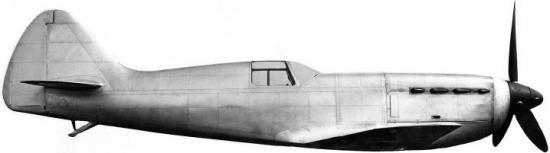
The first prototype of that fighter was the Caudron CR 710, with a fixed landing gear. 

The Renault V 12 engine, at her initial step of development, yielded 420 hp but the fighter achieved 435 kph at altitude and climbed to 8,000 m in 18 minutes.


The CR 713 used a retractable landing gear and achieved 470 kph with her 450 hp engine.


The CR 714 appeared in 1938. 

(source :  les avions  Caudron-Renault, by Mihaly et Robinson, Docavia, 2001)

With a take off weight of 1713 kg, the performances were better :
  • 390 kph at sea level,
  • 476 kph at 4,500 m (480 kph at 5000 m),
  • the climbing times being:
    • 4,000 m ...   7'
    • 5,000 m ...   9'
    • 6,000 m ...  11' 22"
    • 7,000 m ...  15'
    • 8,000 m ...  20' 
    • 9,000 m ...  29' 12"
For all these data, nobody used the extra-power of the new Renault 12 R 03 yielding 500 hp for 3 minutes.


These fighters were rejected if their speed at 5,000 m was slower than 462 kph.

They were also rejected if the climb times were worse than 9' 40" to 4,000 m, 18' to 6,000 m and 30' to 8,000 m.

To use these data, please, remember that the top speed of all the Lioré & Olivier 451 bombers were spread from 462 kph to 498 kph.

In Spring 1940, during the mock up combat against the captured Bf 109 E, the Caudron demonstrated a clearly better manoeuvrability than her German enemy.

Some high level peoples (among those who had so much lobbied to choose the Morane-Saulnier 406 fighter…) predicted the complete failure of the Caudron fighter. 

More than 20 years later, the Chief Engineer Bonte wrote: “always during a war, the best fighter plane will be the most powerful one carrying the heaviest armament”. 

If Master Yoda, in another galaxy, far, far away, had known this arrogant man, I'm sure he would had say him: "So certain are you!" 

Perhaps, the 334 US pilots who were downed by the nimble Vietnamese Mig 17 or 21, 3 to 4 times lighter than their own plane, while flying their F 105 Thunder-chief (weighting up to 24 metric tonnes), did not share such an opinion? 

Their losses were even worst than the ones of the Potez 63-11 Recce plane during the Battle of France!


In action


Alone among all the lightweight fighters of the WW II, the Caudron CR 714 Cyclone reached the operational status during a true war time. 

Moreover, she fought the Luftwaffe she was intended to fight. 


However, the more robust and most interesting opinion is the one of Captain Laguna, the leader of the Polish unit. 

In his report, he wrote when he was in Great Britain (thanks to Mathieu Comas who translated it to French in his book – les chasseurs Caudron CR 714, Avion, hors-série #11 ). 

For Capt. Laguna, the CR 714 was especially well designed and built. 


Nevertheless, he expressed strong regrets about the lack of detailed service manual and, worst, a total lack of spare parts.


This last point explaining perfectly how the number of available fighters was dwingling from a combat to the following one.


During the fighting of the GC I/145, M. Comas authenticated 10 victories, for the price of 3 pilotes KIA and one wounded. 


These victories have been obtained in 10 days, at the beginning of June 1940. 

It is absolutely not bad at all, contrarily as it was told everywhere : The best score of all MS 406 units was deserved by GC III/1, claiming 36 victories (after gathering all confirmed and unconfirmed victories). 
The 10 days rate of victories seems very similar (10 for the CR 714 / 9 for the MS 406), but its 8 victories obtained the May, 10, were on isolated bombers. 

The conditions between the June 2 and June 12 were much more dramatic ! 

So, the CEMA beloved Morane fighter, in a good fighter group, with a much more steady strength, did not obtain better results than the constantly vilified Caudron Cyclone.


One may wonder about the reason why the Caudron was never used by any regular French unit. 

If it had be done, this fighter could be better known, more reliable and the spars would have been collected in sufficient amount.


My only technical regret regards the weapons fitted in this plane – four 7.5 mm machine guns, gathered in a voluminous “suitcase” in each wing – even though a couple of 0.5 cal. Browning would have given a longer range and a much stronger punch (as also a significantly better speed). 

In such a case, the Cyclone fighter could obtain very much striking results !


My personal opinion is the Caudron Cyclone, once finalized, could have been a very better fighter than the Morane MS 406.




Monday, April 9, 2012

The experimental ordering of fighters: A reaction against the Hal complex (revised October 27, 2022)


Three fighters have been ordered in experimental series by the French Ministère de l'Air while they have been previously rejected by the official technical survey.


The big concern of General Vuillemin


The choice, at the end of 1936, of the Morane-Saulnier 405 as a standard fighter by the Armée de l'Air chief of staff, general Fécamp, a friend of the Ministre de l'Air, Pierre Cot, appeared as a big mistake to all high rank airmen soon after the brilliant performances of the Messerschmitt Bf 109 in the Zürich Meeting of 1937. 

Worst, the inability of the Morane-Saulnier factory to fulfill quickly the orders triggered a new approach about the standardization concept.

At the end of 1938, the MS 406 fighter was not able to master the older Spad 510 fighter in mock combats.

The Armée de l'Air stroke back in two ways. 
  • The first one was to favor new orders for different existing fighters : The Bloch 150 M (which became the MB 151 and her progeny), the Caudron 710 familly and the Curtiss H 75 (P 36).
  • The second one was to  favor the creation of a lot of new fighters, even if the concepts used were very different from the official programs.

We know, today, that 3 fighters were ordered, and for 2 of them, the information was given only by the German troops!

These fighters were ordered without the CEMA endorsement!


The Dewoitine 551 


The Dewoitine 551 have been initially rejected without any trial because the prototype, the Dewoitine 550 - a very promising world airspeed record breaker, reaching 705 kph at 6,500 m - did not respond to any official program.


Dewoitine D 550 prototype 

The performances of the D 550 resulted from a very streamlined shape, and a take-off weight of only 1,800 kg (rising to 1,950 kg at the end of May,1940). 

Nevertheless, the famous test pilot (and French Air Ministry missi dominici), Michel Detroyat,  was sent by General Vuillemin (Chief of Staff for the French Air Force) to evaluate this fighter.

He was highly enthusiastic, suggesting to increase the wing area of 2 m² to take into account the additional weight of the weapons.

His report had triggered an immediate order of the Armée de l'Air for 18 fighters.

The D 551 fighter retained the main structure of the D 550. 

The maximum drag area was 0.889 m², to compare with the 1.02 m² of the D 513 and even the1.056 m² of the D 600 fighter designed for the Spanish Aviation for1942-4.

The length was 8.20 m (D 520: 8.60 m).

Obviously,with armament, armor and oxygen, the take-off weight rose to 2,150 kg.

So, the wing area was increased, rising from 10.79 m² to 13.048 m², to conserve the wing loading of 165 kg/m² of the D.520. 

The thickness of the wing was 17 % at the roots and 10 % at the tips.


Dewoitine 551 as seen during the 1941 winter - picture from Aviafrance


The top speed was (at least) 650 km/h and the climb to 8,000 m was better than 7'. 

The only shortcoming regarded the weapons : Five light MGs (another possibility was to have only one 20 mm gun in the engine).

Three D.551 were about to fly at the cease-fire time, and sixteen in various stage of finishing.


The CAO 200


The CAO 200, designed by engineer Marie (who created the Nieuport 161 C1), produced by the Nieuport team, had very smart wings (the layout of this fighter anticipated almost perfectly the one of the Mig 21) but she never received the expected Hispano-Suiza 12 Y 51 engine, instead she was fitted with the poor 12Y31 .

The top speed was 552 kph and the climb to 4,600 m needed 5'35".

One may translate such a value as ~4' 50" for 4,000 m.


CAO 200 - picture from Aviafrance  


These performances were better than those of the D.520, being obtained with less power and 1,000 m lower.

Nevertheless, the French technical survey rejected the aircraft. 
The same extra test pilot Michel Détroyat reassed the CAO 200, found her very easy to fly, very maneuverable and appreciably fast.

Twelve fighters were under construction with Hispano-Suiza 12 Y 51 engine (allowing them a top speed close to 595 - 600 kph) when the German troops irrupted in the SNCAO plant.

One noticeable property of this fighter was the extensive use of electric welding in place of the traditional riveting for the light alloys monocoque structure.


The Hanriot 220


Initialy, this all metal fighter used two Renault 12-01 engines delivering 450 hp.

Her fuselage was 8.24 m long (just 7 cm longer than a Morane 405 monoplace).

The elliptical 
section of the fuselage (0.90 m x 1.57 m) did not exeed 1 m² of  front surface .

The wing span was 12.80 m and the wing area was 21.16 m²
.

Cependant, les Gnome et Rhône 14 Mars en étoile de 650 Cv parurent plus aptes à fournir de meilleures performances.

Empty, the weight was 2 210 kg, for take off, it increase to 3160 kg

Her teething troubles were numerous and were fixed rather late. 

Initially, the Hanriot 220 was found very unstable, that was attributed, as usual in the CEMA, to an insufficient horizontal tail surface. 

However, if you look to the photography below, you can see how abnormal was the huge cockpit canopy, with a gigantic hole for the rear gunner ! 

In this case, the initial Hanriot 220 fighter, with her two Renault R 01  could have been an interesting single seater (a tiny Westland Whirlwind).

The deletion of two seats coud save about 600 kg (take off weight averaging 2 600 - 2 700 kg). 


The NC 600

The NC 600 was issued from the Hanriot 220 twin-engined fighter of 1936. 

Hanriot 220 as seen initially - See how the cockpit canopy masked completely the vertical tail surfaces at slow speed...


However, the performance were good, as the fighter top speed was 542 kph and her climb time to 8,000 m needed only14'.


CAO 600 - picture from Aviafrance   


The CEMA rejected the fighter, because it favored unduly the very heavy and more powerful SE 100 fighter (580 kph at 6,000 m).

These people were also involved in the ordering for the Lockeed P38 Lightning, which, deprived from her turbo-supercharger (because a US Senate law protected the American military technological advances) would have been very slower, unable to reach a normal climb ability, and to summarize, an aircraft of very little utility (as it was judged by the British experts in 1941).


One NC 600 captured by the German troops - the air intakes were very narrow !


Nevertheless, the German soldiers discovered six NC 600 under construction when they were occupying the Bourges facility.


Some lessons ?

Indeed, this very unusual behavior of the French Air Ministry looks like a tool to bypass his own technical surveys!


Why such things happened ?

Because, among these 3 star-programs launched in 1936-1937, two (Morane 406 and Potez 631) have given pleasant planes plagued by alarmingly low performances. 

The third (LéO 451) although being relatively fast and maneuverable in flight, was very hard during the take off (abnormally high rate of fatal accidents : 20% of the total operational LéO bombers were written off before the May 10 !).

Moreover, two of these airplanes (Morane 406 and LéO 451) were very slow to build, inducing the need to dedicate all aeronautic plants to build these bloody aircrafts (OK, I know the Spitfire needed the same time than the Morane, but she was undoubtedly a considerably better fighter deserving to be manufactured in large amount - I must add that, considering the 22,000 hours needed to build the Macchi MC 200, the real building time of the MS 406 was likely similar).

The method used here to overcome this obvious "administrative viscosity" affecting this peculiar selection process, looks like a Darwinian process.

The official test pilots were seen as "too much skilled" to be representative of the main population of military pilots.

So, the parallel trials made by an acknowledged super test pilot illustrated a clear adaptation to a new, very fast method to gave a clear view to General Vuillemin about any new aircraft.

That displayed also a clear refusal of previous methods which had given so much abnormal results.


If France did not be defeated in June 1940, the results could have been very interesting.

The trial-and-error method had proved its superiority to the previous one, but we don't know exactly the causes of their failures, even some corruption might be suspected in some cases.

The experimental squadrons sent to the front could give a more relevant judgement (as it was the case when "normal" pilots had flown the Amiot 351 bombers, they felt so delightful to fly !).


That may also be interpreted as a mechanism of resistance, as those developed by any living organism against cancer.

This French Air Ministry bureaucracy was a very creation of this Ministry. 

It was growing day after day, developing - by chance - some good ideas and methods. 

After a long struggle to be heard, mainly because aircraft maker were very short of money, it had developed its own rules raised at the level of God's laws.

So, it became a true monster which destroyed a lot of the French aerial capacities.

One may compare this process to the Hal computer in the Arthur C. Clarke's: 2001, A Space Odyssey
Then, men were obliged to bypass the tool they needed to survive...

I wonder why the French 
members of parliament, who represented the Nation, had not detected such a bias.

If they have known it, they could have reduced this excessive independence so as to give the power to the real users: The front pilots.

But I wonder also if these PM like to work...


Misinformation, even today, about the WW II History (revised 26 / 06 / 2020)


Always the war is a powerful leverage used by countries to fulfill their political needs. 

This induce a well known connection between war and propaganda. 

Indeed, the propaganda was used to an an extraordinary high level during all the WWII (and, may be, ever during the present days).... 

In this way, the German propaganda was strong and used a lot of different channels to reach its goals (while the French one was completely useless). 


The true Hitler's goals


The Hitler’s goals were to transform the North Europa in a huge German land. 

For that purpose, the Führer needed the alliance of the South Europa (Spain and Italy) and the neutrality of the United Kingdom.

Hitler must also absolutely delete France for three reasons : 
  • this nation was a potential and powerful military threat behind him if he attack the Est side of Europa ; 
  • since the 18th century, France had developed and exported a lot of concepts which are absolutely deadly for all politics based on inequality between people (concepts obviously contradictory to the own French colonization policy...) ; 
  • France had a real love for the Democracy, even the actual 3rd Republic was very "special" on this point of view (the women were excluded from votes). 
So, a simple military victory against France was insufficient for Adlof Hitler

He need a moral annihilation of this nation.

Among the means used, the Molotov-Ribbentrop treaty in 1939 introduced, in France, a division between communists and other workers leading to many strikes, incidents and, likely, sabotages. 

Depriving the geographical unity of the country by the annexion of Alsace was running the same way. 

This was not sufficient for Hitler.

The French people must be humiliated mainly in his military self respect. 

To reach that goal, he used the Blitzkrieg, focusing its own offensive to the maneuvers of two experts on the subject: Guderian and Rommel. 

These two generals jostled the French Staff (may be the oldest one in the world, thoroughly cleared - by the IIIrd Republic politicians - from any general able to renew the French military methods). 

The idea was to break the front before the French troops can understand what happened to them. 

The exceptional quickness of the operation provoked some panics and the completion of the psychological maneuver was obtained when “neutral journalists” (see W. Shirer: Berlin Diary) were used to testify that “French soldiers does not fight at all”. 

The reality was a bit different. 


The fights


French soldiers fought fiercely, as during the Stonne battle where the German Gross Deutschland elite division (= special forces) and the 1st Panzerdivizion clashed from May 15 to May 25 with total losses of 26,500 casualties among them 3,000 KIA, three times more than the French losses in the same battle, as also during the Hannut tanks battle, as also the Abbeville offensive of De Gaulle, who induced real panics in the German troops. 

The great success of the Dunkirk evacuation was build on the sacrifice of the French soldiers (11,000 KIA + 34,000 POW) who hold quite alone the perimeter from May 25 to June 4 against the strongest part of the Wehrmacht (which suffered from 20,000 casualties).

In the air, the German propaganda was as efficient than everywhere. 


The German losses? Largely underestimated from 1939 to 1941 


The best example is given in his book Famous Fighters of the Second World War by William Green (p. 11, vol. 1, 1960) when he wrote “the tendency to swing on take off and landing [of the Messerscmitt Bf 109]” "contributed substantially" to the accidental loss of 1500 fighters in the first two years of the war


The available official German amount of combat losses of Bf 109 fighters were: 
  •     67 during the Battle for Poland, 
  •   205 during the Battle of France and  
  •   610 during the Battle of Britain.      
To these 882 losses, one had to add at most:

  100 losses for both Norwegian and Balkan operations. 

One may estimate losses during the Barbarossa until September 1941 operation to be at most 400 fighters 

This giving a grand total of about 1,400 losses "claimed".

Such an amount is silly! 

The Jagdwaffe pilots would have been more dangerous for themselves than the pilots who fought against them (!). 

I cannot believe such a fairy tale. 

The only self dangerous pilots are those who cannot fly sufficiently. 


During these 2 years, the German pilots suffered no flight restriction at all and they were excellent.

Indeed, the amount of accidental losses reported by Green was a typically nazi method to disguise their combat losses, especially those caused by Slave (Polish or Russian) or French pilots.

Its would be absolutely reasonable to think the losses of German fighters were twice of the claimed ones.


Wednesday, March 7, 2012

Munich 1938: Democracy, Truth and Defense of the Nation must be associated (revised 15 / 12 / 2018)


A failure of all Allied intelligence agencies


As certainly you know, during the Summer of 1938, Hitler having successfully achieved the Anschluss between Austria and Germany, threatened again the European nations to go at war: He said he will attack the Czechoslovakian Republic for unification of some German speaking people with his so-called Third Reich.

The Czechoslovakia mobilized her excellent Armies while Mussolini suggested a Peace conference in which, amazingly, the Czechoslovakia and the Soviet Union were not invited (!). 

Feverishly, this so-called Peace conference opened the September, 29, in Munich.

Two week before, the September 15, Mr. Neville Chamberlain flew to Berchtesgaden to make his famous (in fact, infamous) agreement with the German dictator.

Unfortunately, the French premier, Mr Daladier, was not able - for a lot of psychological reasons - to withstand to his British colleague.

Doing that, the British premier was sincerely convinced he avoided the war for his country.

Nevertheless, at the exception of the German HQG, it is doubtful that everybody among the British and French deciders had in their mind that the young Czechoslovakian republic was loosing all its fortifications (built thoroughly as another Maginot line). 

The door was open for Hitler to have all the excellent Czech weapon's plants to his disposal, that was a major asset to anybody wanting to make war.


You prefer the most compliant generals ? You will lost the next battles


The neurotic instability of the French 3rd Republic played a major role in such a drama. 

French pacifists, full of their inclination to "peace at all costs" and lacking from any common sense, were backed secretly, but efficiently, by nazi agents who were also numerous in Great Britain. 

French and British politicians were completely outmaneuvered by the German dictator.

OK, the French Président du Conseil (= Prime Minister in the 3rd and 4th French Republic) have asked the chiefs of the Army's advice. 

Who were these important French military deciders? 
  • General Gamelin, supreme commander of all French military forces and top general of the Land Forces, 
  • Admiral Darlan, commanding all the French fleets, 
  • General Vuillemin, commanding all the French Air Forces.

All have been chosen, at first, not because they were excellent strategists (as it was falsely told later) but because they were very quiet from a political point of view! 

At this very moment, the hideous spectra of a new World War had arisen, such a choice was very strange.

For example, Admiral Darlan was the son of a former Minister of the 3rd Republic, a close friend of the Minister of Marine Georges Leygues who made him his personal adviser from 1926 to 1934.  

This had incredibly boosted his career: Rear-admiral in 1929, vice-admiral in 1932. 

As usual, he used his administrative functions to create a friendship network.

One may say he was very late to understand the importance of the radar / sonar in warships as he did not understand the role of the aircrafts for a navy (maybe this last point may be linked to his rivalry with Admiral Jean de Laborde).


General Gamelin was said as a good second of generalissimo Joffre during the beginning of the WW I. 

{Many Frenchmen interested in WW I know that general Joffre himself was not a good choice, the Marne Battle of 1914 was triggered by the general Gallieni.}  

Gamelin was too much convinced that a strong political backing was absolutely needed. 

He demonstrated a complete inability to taking into account all the advances in tanks and aerial warfare. 

A generalized opinion about him was that he was very clever... May be, this statement has be popularized in France by the German staff!

For your own evaluation of his strategic capacities, remember, at the beginning of the WWII, after the Molotov-Ribentrop pact, General Gamelin really planed a French aerial offensive against the Bakou petrol, in order to disrupt the fuel supplies of the German army! 

For that reason, general Weygand, former leader of the French Armies, was sent in Lebanon. But such a "strategy" looked like suicidal, as it implied a war against USSR with a front being at 4,000 km from France! 

French armies, but Gamelin, never forget the lessons learned during the Russia Campaign they have experienced in 1812...


For the Air staff, after the disastrous firing of General Pujo in 1936, in order to give his command to general Féquant, who was only a political friend of Pierre Cot, the Minister of Air, the Armée de l'Air was in bad mood. 

Féquant was responsible of refusing to order the Nieuport 161 fighter, the Bréguet 462 and the Amiot 340 bombers which were good performers and soon well perfected. He was also responsible of the choice of the bad performing Morane 406 fighter and the totally un-perfected (and very dangerous) Lioré & Olivier 451 bomber.

So, the new Minister of Air, Guy La Chambre fired Féquant and chosen General Vuillemin, a very experimented bomber pilot and an ace (yes!) during the previous war. He always demonstrated a great courage and a real interest about some technical questions. 

Nevertheless, at the arrival in his new function, he seemed unable to have any strategical nor tactical conceptions. 

During the 1938 year, he appeared completely overwhelmed by the rising power of the Luftwaffe, but, since the summer of 1939, he seemed more adapted to do the job. 

But the time wasted from 1937 to 1938 was never recovered.


1938, the lost chance


If Vuillemin had not been deceived during his visit to the Luftwaffe, may be he had time for some meditations. OK, after some bad choices, like the choice of the poor Morane 406 as standard fighter, the Armée de l'Air was not at its best. 

However, with an outbreak of war in October, the Luftwaffe could not be as powerful as it was possible in dry and hot weather. 

During the Fall, statistically, the Western Europa is crossed by atmospheric disturbances, with a lot of huge clouds, with frequent icing conditions, no ceiling and strong winds. 

These conditions were not very good to launch any aerial offensive.


The French Bombers: More capable in 1938 than in 1940


Moreover, the French bombers like the Bloch 200, Amiot 143 and the Bloch 210 were really outdated, but they were sturdy, reliable and the Bloch 210 could fly 2,000 m higher than all the Messerschmitt Bf 109 B, C or D fighters.

The Bloch 210 was the subject of a strong denigration campaign after several crashes caused by the poor qualities of their engines and air-screws (which induced devastating vibrations). 

After engine changes, this bomber became safe and served fairly during the Battle of France. 

They were less outdated in 1938 than in May 40, isn't?


Regarding the fighters, the Jagdwaffe was the most impressive fighter army in the World in September 1938, with 600 Messerschmitt Bf 109 C or D (the half of the amount available in May 1940, with 100 kph less top speed than the E variant!).

However, during the whole July month, only 50% of the German fighters were airworthy, owing they experienced a lot of teething troubles. 


The French Air Force had 15 Morane 405 and, at best, 10 Potez 630 twin engined fighters, all of these 25 planes being equivalent, or even better, to the actual best German products.

The awareness of this accountancy was obviously very clear in the mind of general Vuillemin. But it was not the good one.


Fighters of the preceding generation (Dewoitine 500, 501, 510, Spad 510, Loire 406) were not defenseless against the actual 700 hp motorized Bf 109. 

OK, a Dewoitine D 500 was 90 kph slower than a Bf 109 D, but she had a very better climbing ability (about 3' faster to reach 6,000 m) and a service ceiling 2,000 m higher.

They had a possible way to escape a German fighter attack and to oblige them to fight at very high altitude, where they were slower and not maneuverable at all!

Do you think really that was worst than the 115 kph deficit, the loss of 3' to reach 5,000 m and the at least 1,000 m lower ceiling of the Morane 406 against the Bf 109 E?


Simultaneously, Czechoslovakia had up-to-date fortifications (à la Maginot line), a very excellent set of tanks and antitank guns, several hundreds of Avia 534 fighters, as fast as the D 510, but better in climb and maneuverability and manned by exceptional pilots.


Soviet Union had some possibility to attack the IIIrd Reich by sea or by air in order to stop the iron supply from Sweden.


If Hitler wanted to attack France first, he did not have the power he had 2 years later, by far. 

His only armored vehicles were the Panzer I and 2, with a rather thin armor and weak guns. 

He would lack all of the ~700 medium and heavy tanks he benefited later in 1940.

So, my opinion is that Hitler had no chance to win such a conflict.


The problem that Edouard Daladier experienced, was he did not step back about his own generals. 

The RAF had, actually, about 200 modern fighters but they cannot be added to fight against Hitler, as the British Prime Minister Chamberlain did not want at all to go to war against the nazis.

That was a vicious circle. 

As many French politicians, Daladier did not proceed to a complete analysis of the strategic problem. 

His first concern seemed not to found the best way to stop Hitler, but to avoid the disintegration of his own government.

Yes, he had a good sight on Hitler real aim, yes, he knew the war was unavoidable - as Churchill too - but, as all other French politicians of the third republic, he had eliminated all officers who had a real strategic view, as he did against the genius Charles de Gaulle.

The Democracy is a very difficult exercise: The People must be educated - without propaganda - and then, you must tell him the Truth.

How obtain war funds when you have been elected after an ultra pacifist campaign?

Moreover, any war is always horrid. 

But, before rejecting that bloody way, one must wonder if peace is the real solution: In 1938, it was not the case at all. 

The following events demonstrated this.