An excellent fighter plane, but why nobody said me how to use her!
At the beginning of WW II, the Potez 631 was - with the British single seat twin engined Westland Whirlwind - one of the very few twin-engined fighter able to execute as tight maneuvers as her single engined, single seat, counterparts.
{Source : Les Avions Potez, by Jean-Louis Coroller & Michel Ledet, Lela Presse - in French}
She was fitted with two Gnome et Rhône 14 M engines delivering 670 hp.
The top speeds for different altitudes were:
The top speeds for different altitudes were:
- 364 kph @ 0 m,
- 382 kph @ 1 000 m,
- 434 kph @ 4 000 m,
- 455 kph @ 5 000 m,
- 455 kph @ 6 000 m,
- 445 kph @ 7 000 m.
The total range was 1 000 km and the minimal speed was 110 kph.
The climbing times were :
- 1 000 m in 1' 25",
- 2 000 m in 2' 50",
- 3 000 m in 4' 20",
- 4 000 m in 5' 40",
- 5 000 m in 7' 15",
- 6 000 m in 9' 15",
- 7 000 m in 11' 30".
The measured diving speed was 780 kph, 40 kph faster than the MS 406. The Potez 631 was clearly faster than the Morane-Saulnier fighter!
The armament was 2 Hispano-Suiza HS 404 canons fixed beneath the fuselage (a bad choice, aerodynamically speaking) + 2 forward firing riffle cal. MAC 1934 machine guns and only one rear firing.
Due to strict instructions of the High Command, the Potez 631, as all her other French contenders, was fitted with a twin fins and rudders tail.
Such an odd choice induced a larger weight, a slight speed loss, and need more attention during take off, when the extended landing gear aerodynamically masked the rudders...
The wing area was 32.7 m², giving her a 115 kg/m² wing loading; That allowed her a very tight turning radius.
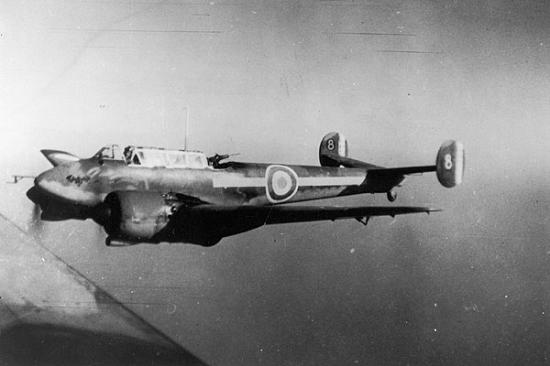 |
| Potez 631 - |
So, the Potez 63 fighter had exceptionally good flying qualities, a very strong armament and a reasonably good range.
Moreover, she was especially designed for mass production: She needed half the time needed to produce a single Morane 406!
What were the feeling of their pilots ?
Henri Cormouls (grp I / 16) shared with us (in the splendid Icare review, during the 70's) his personal opinion about this fighter he beloved a lot:
"One had created a squadron [ECMJ = Escadrille de Chasse Multiplaces de Jour] equipped with Potez 63; She was not a very fast aircraft, nevertheless, she was an extraordinary fighter because she was fitted with a very potent armament : Two canons and two machine guns forward firing. All these weapons were triggered electro-pneumatically, an absolutely sensational device.
[The Morane 406 and Bloch 152 had a pneumatic trigger which induced a 0.3 second delay before firing, a heavy shortcoming during a dog-fight!]
We were the only one squadron so equipped. It was a day light squadron to counter the German Messerschmitt Bf 110.
A big mistake was our really too weak engines: With 100 or 200 hp more potent for each one, we would have the best war machine of the World.
(...)
I was very well trained on this fighter. She was extraordinarily maneuverable, she had a good climbing ability, she was fantastic and really heavy duty".
So, more than 30 years after the Campaign of France, this pilot continued to love the Potez fighter, even he always dreamed about more powerful engines.
Unknown precursor...
At the end of 1936, some eminent thinkers thought the fighter pilots are young people unable to see the good tactics during the aerial combats.
At the same time, some deciders gathered two or three squadrons to obtain Groupes de Chasse.
But, that open new horizons. In concrete terms, the leaders of such units were experienced officers who were close to be promoted to a colonel rank.
So, our eminent thinkers invented a brand new concept: An Aircraft dedicated for Commanding the Fighters (Avion de Commandement à la Chasse in French).
Then, the leader of the unit had to be in one such aircraft, to observe every part of the sky and to dispatch patrols and orders to avoid any surprise for his pilots and to provoke the success of the unit.
One asset consistent with such a purpose was the radio-transmitter/receiver, much more potent than those used in any French single engined fighters.
After some careful experiments, the concept was abandoned.
But only in France.
In USA, favored by the development of inboard computers and embarked radars, we have seen the birth of a very different kind of aircraft following, very successfully, a very similar idea: The AWACS...
In USA, favored by the development of inboard computers and embarked radars, we have seen the birth of a very different kind of aircraft following, very successfully, a very similar idea: The AWACS...
An huge loss of opportunities...
Unfortunately, the French Air Staff, as usual, considered the Potez 631,because labelled as fighter, only as a common fighter, as was, for example, the Morane 406.
But, these high ranking officers did not proceed to any relevant experience with the Potez together with a true production Morane 406.
If they had do so, they could seen how the Potez was more suited as an interceptor than the poor Morane (as you can reed in this post) !
If they had do so, they could seen how the Potez was more suited as an interceptor than the poor Morane (as you can reed in this post) !
Indeed, as a dog-fighter, the Potez 631 may be not as nimble as the Morane, but she can run at her top speed quite indefinitely and she climbed very better, so she was really more suited to catch any kind of German bomber.
Worst, at the time of the German offensive, the Air Staff forgot completely to use his Potez accordingly to her capabilities. These "brilliant" generals forgot almost completely they had an excellent bomber destroyer.
It's amazing, because 210 of them have been produced (as also 80 Potez 630, differing only by the engines fitted). Only a half part of them were in operational units.
Unfortunately, the French Air Staff used these fighters to dogfight with Messerschmitt Bf 109 E which were very rarely alone!
It was not a good idea, considering the inferior speed of the Potez 631 in any conditions, the heavy weight of her elevator, especially at high altitude, and the excess of inertia during the side maneuvers (even if the turning radius of the Potez was clearly the better)!
In these records, there was no mention of the chosen altitude except for the Morane 406 which was always alleged as an easy prey for the American fighter.
The narrative was very different when the Curtiss was opposed to the Potez 630.
In this case, the author of the report wrote: "For the Curtiss, the Potez 630 is a hard to surprise opponent, difficult to shoot and dangerous to attack."
So, she was not an easy prey...
Knowing the generally acknowledged good maneuverability of the Curtiss (a 360° turn needing 12 seconds), this judgment may be seen as very appreciative for the Potez 630.
It could have been even better for the P. 631, which climbed very better than the Curtiss above an altitude of 3500 m.
Nevertheless, the other main asset of the Potez 63 fighter, from a tactical point of view, was her relatively good range, allowing a fair protective ability for the main targets of the German bombers: Airfields, headquarters, weapon plants, artillery batteries and so on.
The Potez 630 and 631 were all fitted with an attitude indicator (Sperry artificial horizon), allowing them to fly safely during the night (after an appropriate training).
So, the May, 9, 1940, when the warning was given of the imminence of the German onslaught, a general scramble, one full hour before the end of the night, for all Potez 63 equipped squadrons, including the two belonging to the Aéronavale, would have been a relevant response for all the German's raids.
Each unit could have sent a light patrol (2 fighters) for covering one airfield.
Among the 96 theoretically existing Potez, 70 were available and were able, this way, to protect 35 airfields.
Among the 96 theoretically existing Potez, 70 were available and were able, this way, to protect 35 airfields.
May be, some of the German bombers might have been deterred, but quite none of their units being escorted in the French sky, so their casualties could have been more striking.
Obviously, to obtain such a result, the fighter units needed some geographic independence (see this post).
In action
The results of the 2 squadrons of the 1st Flottille de Chasse (F1C) of the French Navy, during the 7 days of its combats at Calais, at the beginning of the German offensive.
(source: les Potez 630, 631, 633, by C.J. Ehrengardt Aéro Journal hors série #10).
(source: les Potez 630, 631, 633, by C.J. Ehrengardt Aéro Journal hors série #10).
These results were obtained with an abnormally low strength, only 14 of the 25 fighters were airworthy. Moreover, for some unknown reason, their armament was reduced to only one cannon!
During this week, they obtained 7 confirmed victories, 4 unconfirmed victories, they badly damaged 5 other airplanes for 4 losses.
All the victories were obtained against bombers or Junker 52 military transports.
During the same time, they efficiently protected the Aéronavale's dive-bombers as a lot of Allied convoys.
These 11 victories in 7 days constitute a better result than the best result of the best group of MS 406, especially taking into account the lack of the second canon.
I have already said the radio-transmitter/receiver fitted in the Potez 63 series was very good.
That was perfectly illustrated by admiral Louis Cassé (source: Icare #60, l'Aéronavale dans la Bataille de France, 1972).
He was pilot of a Potez 631 when he was remotely guided over Dunkirk by Cdt Jozan from a British op. room using radar data.
OK, the chase was unsuccessful but it was the first time a French fighter was operating this way.
That was perfectly illustrated by admiral Louis Cassé (source: Icare #60, l'Aéronavale dans la Bataille de France, 1972).
He was pilot of a Potez 631 when he was remotely guided over Dunkirk by Cdt Jozan from a British op. room using radar data.
OK, the chase was unsuccessful but it was the first time a French fighter was operating this way.
Some unused possibilities
Indeed, it was somewhat easily possible to upgrade this very good aircraft.
There was several possible ways.
The simplest way was to fit the more streamlined engine cowlings of the Bréguet 693 (which shared the same engine) and to fit exhaust pipes. If, also, the 2 canons were completely enclosed in the fuselage, the inexpensively modified fighter could have reached a top speed of, at least, 480 kph.
A totally different way was to fit Hispano-Suiza 12 cylinders, liquid cooled motors.
With the HS 12 X (with a displacement of 27 L), the Potez 63 fighter would have exactly the same power but she inherited of a much more aerodynamically refined airplane, according to the chosen cooling devices.
With the known solution tested on the Amiot 370 record breaker and the inexpensive modifications previously described, the Potez fighter could reach 500 kph.
But it was possible to fit two HS 12 Y 31 engines (displacement 36 L, 860 hp at 3200 m). In this case, the Potez 63 could likely fly faster than 520 kph.
Another way was to build her as a single seat fighter, alleviated of ~500 kg, with a reduced wing area (of ~25 m²) and all the previously described modifications: So, the French had got something similar to the British Whirlwind, with more reliable engines.
During 4 long years, the French so-called technical surveys (STAé) were refusing all experiment like this.
Mr Henri Potez chosen another variant, with a much more refined glazed cockpit canopy, elliptic wings of similar area and new Hispano-Suiza HS 14 AB 12/13 engines delivering more than 800 hp.
The fuselage was slightly reduced in size, housing only 2 men.
A 20 mm HS 404 canon was provided to the rear gunner (a bad solution, considering that this excellent weapon could only fire 60 cartridges).
The empty weight rose to 3,180 kg and the take off weight was 4,700 kg.
The main part of this take-off weight increase (~800 kg) was used by the fuel, this fighter having a total range of 2,000 km.
With the same engines than the P 631, the P 671 achieved 502 kph.
So, with the more powerful H 14 AB, she was expected to achieve more than 533 kph.
At the time of the German offensive, the first of the 40 Potez 671 fighters ordered was near completion (as Henry Potez told to Aviation Magazine in the 60's).
Unfortunately, the Potez plant was just in the way of the German Armies...
An other twin-engined fighter for 1941 ?
When the Bréguet Br.697 prototype flew with her Gnome & Rhône 14 N 48/49, she demonstrated incredible performances:
- 570 kph at 4,500 m in top speed;
For the climbing speed, she was also exceptional:
- 4' 53" for 4,000 m ;
- 7' 18" for 6,000 m.
However, this brilliant aircraft had one shortcoming especially for a fighter: Ingenieur Ricard, creator of the Bréguet 690 series, having chosen a mid-wing disposition, the significantly larger GR 14 N engines obstructed the lateral sight of the pilot.
May be, Hispano-Suiza 12 Y 45 engines could have been a better choice.
May be, Hispano-Suiza 12 Y 45 engines could have been a better choice.
If the CEMA pilots said this fighter very difficult to fly, such an opinion was vigorously contested after the war by her test pilot, Maurice Claisse, who went to Great Britain during the war and was used as a test pilot.
One may easily explain the CEMA's pilots opinion, derisory but usual, because this fighter had the same power plants than the SE 100, was 2 tons lighter, very easier to build in mass production,and was certainly more nimble.
The RAF demonstrated that a twin-engined fighter was an efficient concept.
Certainely not with the Blenheim Mk I F or Mk IV F, but with the excellent Whirlwind, the Beaufighter, the Mosquito, and the gorgeous Hornet.
Not for establish a domination over the single engined fighters, more nimble, but to have a long distance fighter enabling the possibility of actions where your presence is not expected.
The perfect example of such an action was the assassination of admiral Yamamoto by sixteen Lockheed P 38, the April, 18, 1943.


